Stories | Caring community
Caring Community
Building caring environments together
The Netherlands is not experiencing a temporary wave of ageing, but a lasting demographic shift. In 2040, our country will have almost 5 million people aged 65 and over. The number of people with dementia is expected to double. At the same time, the proportion of single-person households is growing rapidly: by 2045, over 40 percent of all households will consist of one person. By 2030, more than 288,000 more suitable homes will be needed for older people.
But these figures are about more than the increasing demand for care. They mark a fundamental shift in how we live together. Vulnerability is no longer an exception, but a normal part of our daily life. Older people live independently for longer, even as their capacities gradually decline. Informal care is becoming more important, but it is not infinitely available.
A less visible but equally significant development is growing loneliness. Social isolation is increasing not only among older people, but also among the young. This is not only a question of wellbeing. International health studies show that only about 10 percent of our health is directly determined by medical care. Between 55 and 80 percent is linked to lifestyle, social relationships and the quality of the living environment. When social connection declines, physical health and pressure on the care system are affected too.
The central question is: how do we organize living environments in which people can meet, form meaningful relationships and feel part of a community? Care is no longer a separate phase of life, but an integrated part of how we live. The care transition is therefore not merely a medical question. It is a design challenge.
Health is shaped in everyday life.
For a long time, the spatial organization of care was based on a single idea: illness is treated in specialized institutions. Architecture served as infrastructure for medical intervention, focused on control and efficiency. Contemporary public health insights point in a different direction. Health does originate primarily in the clinic, but in daily life, to the degree to which people feel safe, connected and autonomous. The built environment plays an active role in this. Living, meeting and participating in the community are not preconditions for care, but its foundation. This also changes the economic logic. Investing in the living environment and community-building at the front end reduces the need for intensive care at the back end. A strong social structure relieves formal care and strengthens informal networks. Architecture and urban design thus become a strategic factor in the care transition.
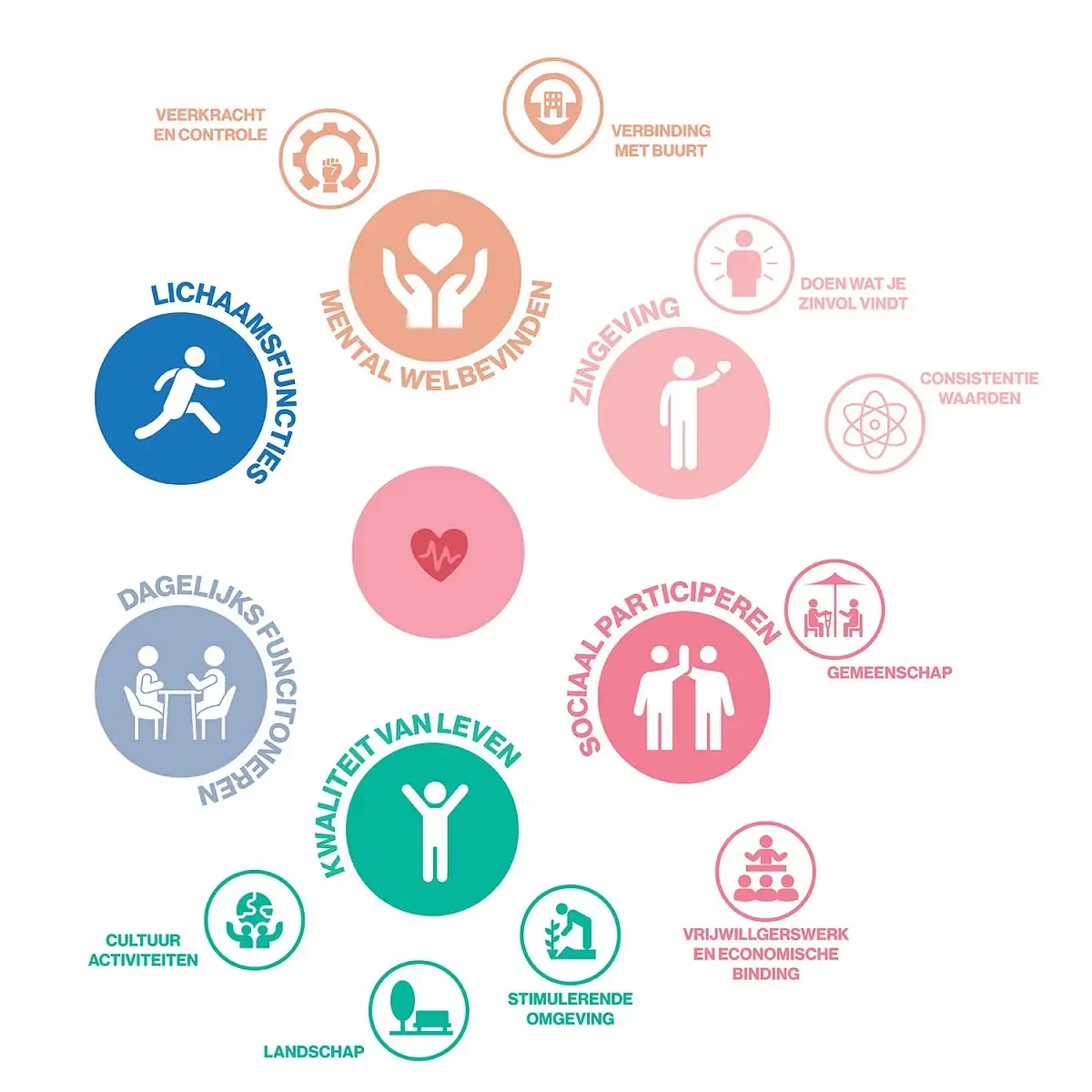
Diagram quality of life
Collective self-reliance as a foundation
Clustered housing models offer an answer to the growing need for suitable housing for older people. They combine self-contained homes with a shared structure and communal facilities. The core of this housing model lies in what we call *samenredzaamheid*, or communal self-reliance. Where self-reliance assumes the individual on their own, communal self-reliance recognizes that people are part of social networks. Mutual involvement and informal support make it possible to live independently for longer. Communal self-reliance is not a social program separate from architecture. It appears through careful organization of proximity, visibility, and accessibility. The transition between private and collective is clear but not abrupt. Residents meet each other in the daily rhythm: while gardening, having coffee, coming home.
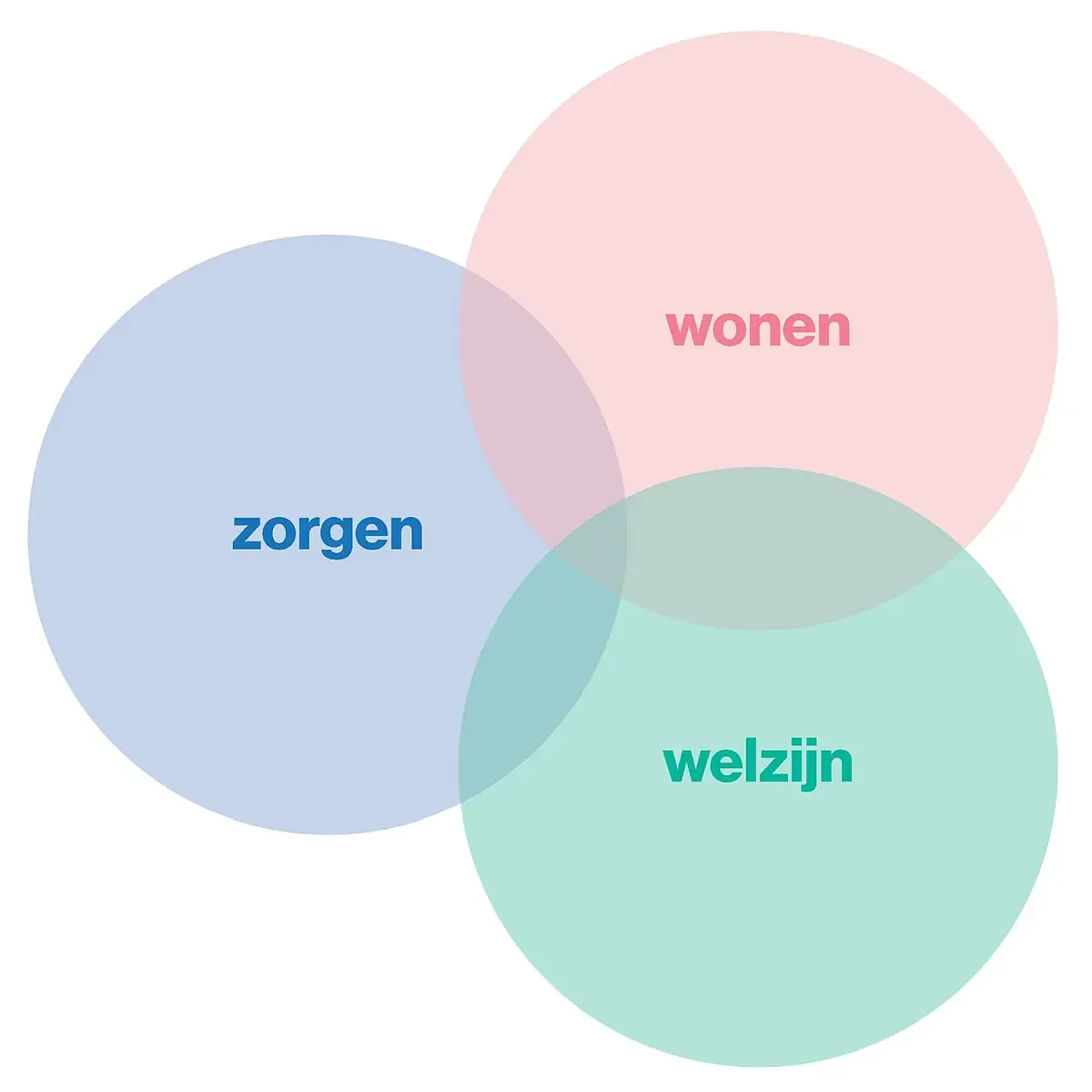
Diagram living, caring, wellbeing
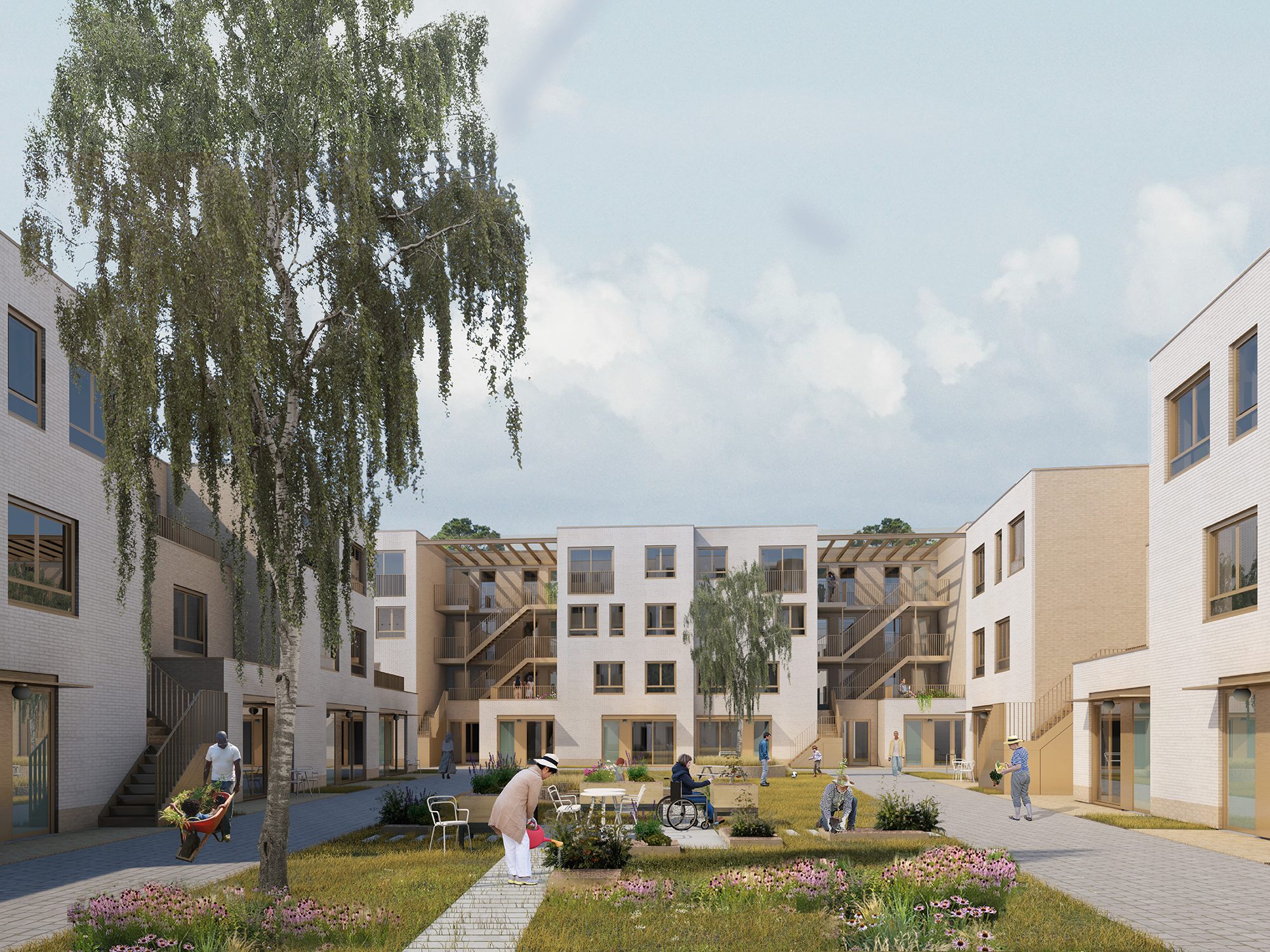
In the Ubuntuplein project, it becomes visible how these principles are translated spatially. Older residents live here in a setting that encourages social interaction without losing independence. The homes are designed to be fully wheelchair accessible, with wide corridors and spacious bathrooms. Communal gardens, meeting spaces, and shared facilities invite informal contact. Residents look after the garden together, sometimes cook together, and keep an eye out for one another. The result is a safe, inclusive living environment in which people feel at home, not despite their vulnerability, but together with one another.
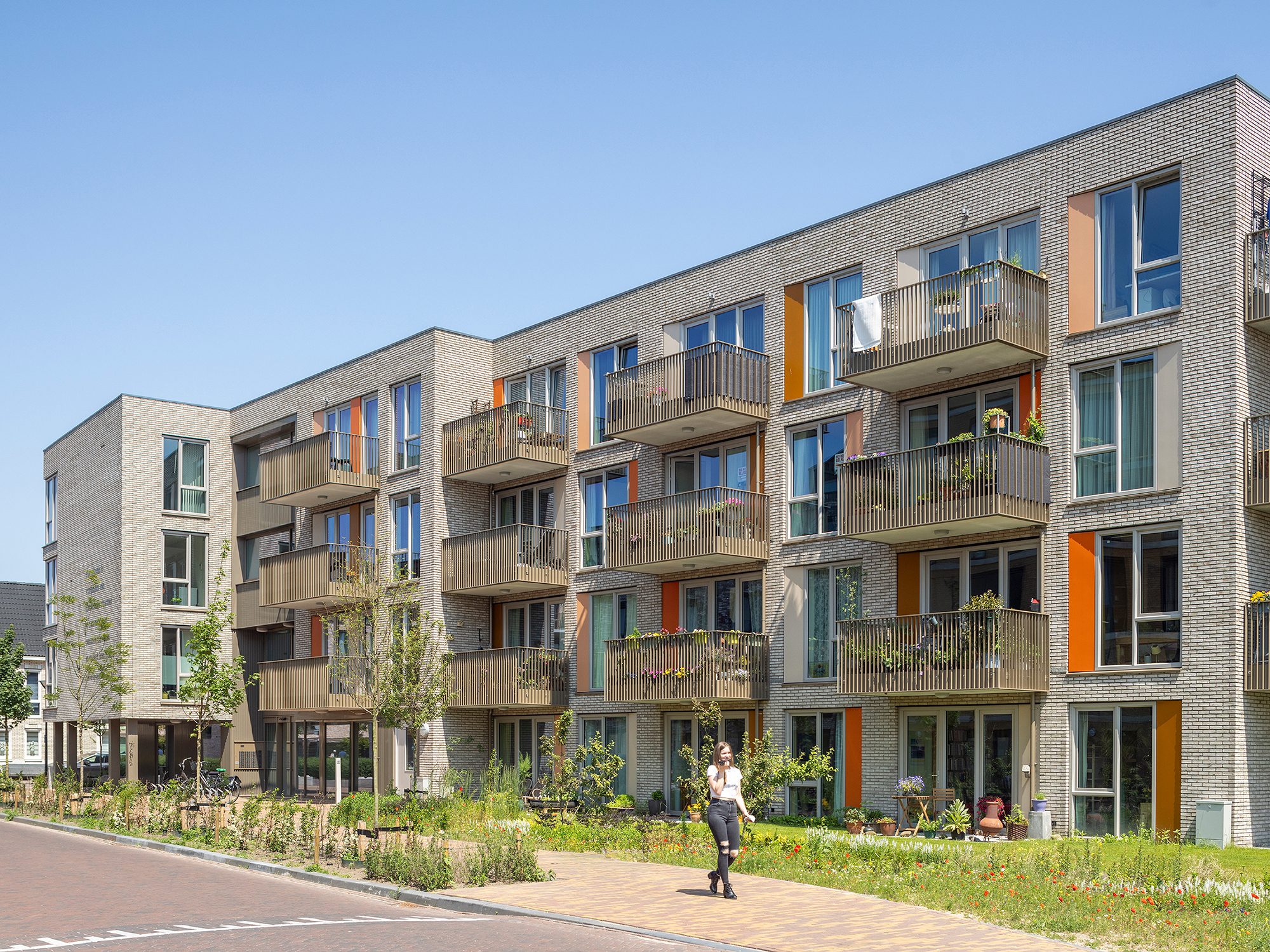
Care buildings as part of the neighbourhood
A caring living environment cannot function as a closed enclave. When care buildings isolate themselves from their surroundings, they reinforce the sense of seclusion. Future-proof care is interwoven with the daily life of the neighbourhood.
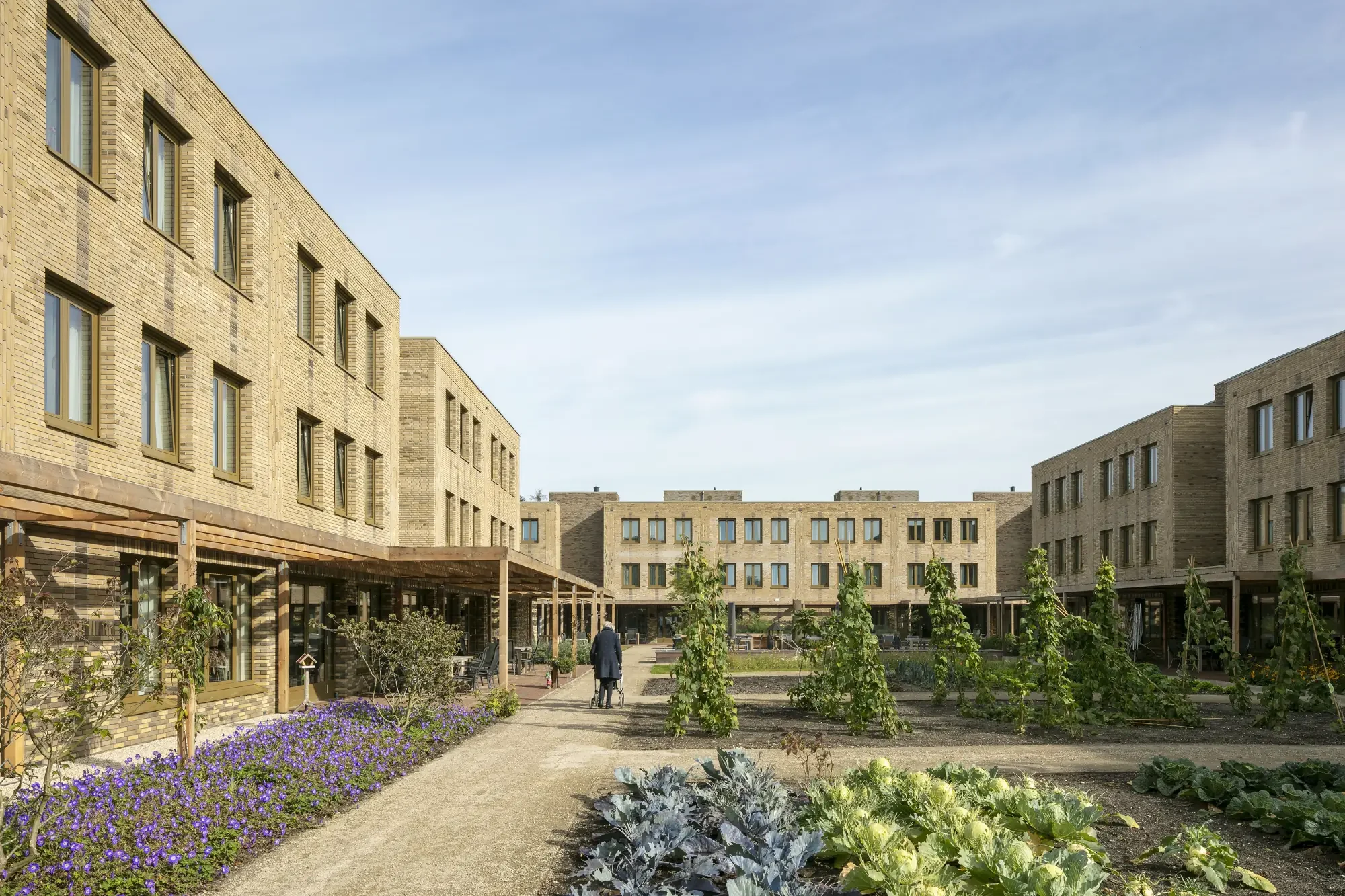
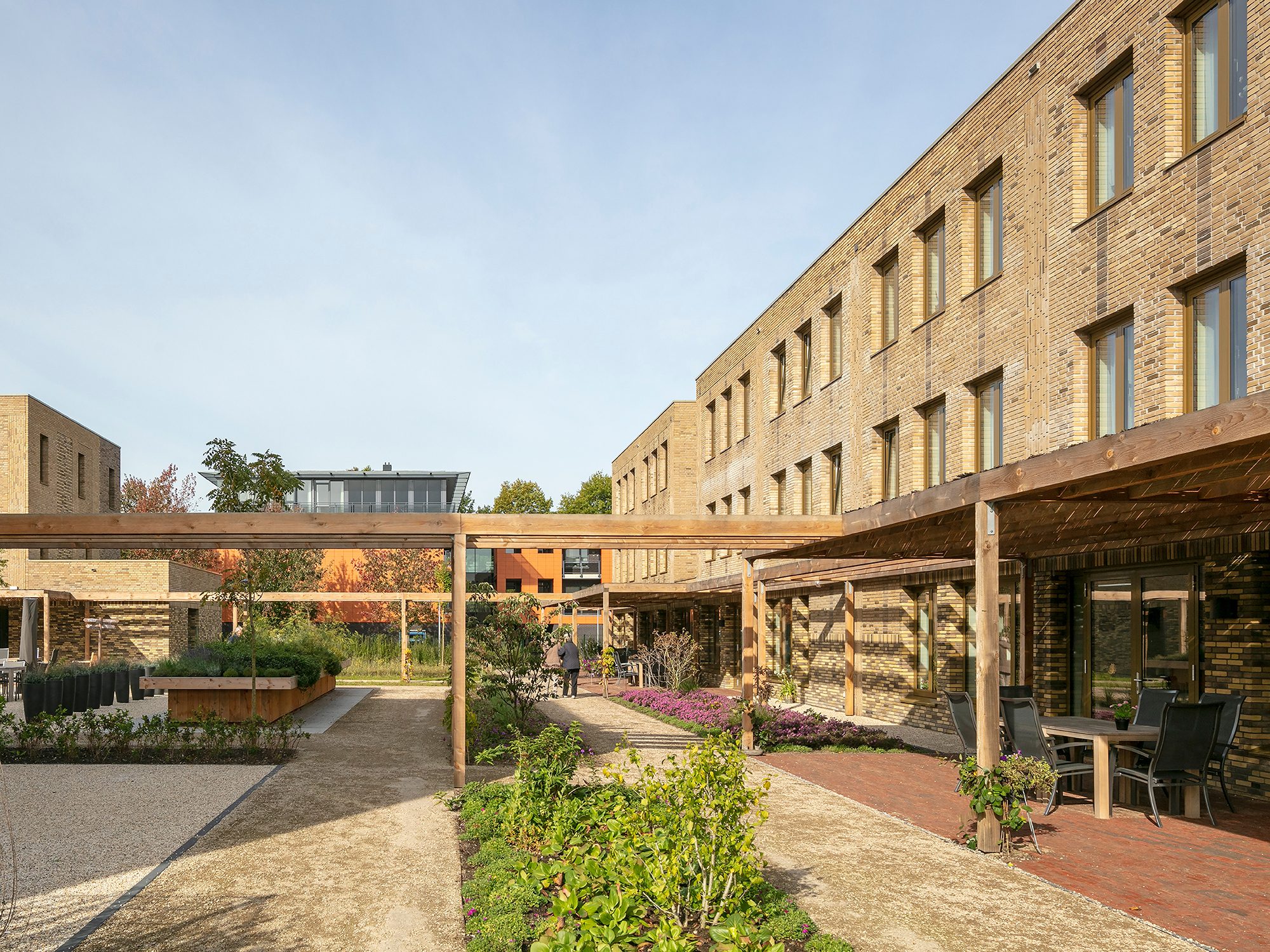
At Hofje Wendakker, this vision has been translated into an open courtyard structure with twelve living rooms arranged around a green inner garden. The traditional care home for people with dementia was replaced by an open, informal courtyard that is connected to the neighbourhood. Instead of long, closed corridors, a legible environment appeared in which residents can move freely and where outdoor space becomes a natural part of the daily rhythm. The garden and animal paddock are freely accessible to residents. Residents decide for themselves when to go outside, which has led to more movement and a better day and night rhythm. The result is a care environment that offers not only medical care, but also quality of life, rhythm and meaningful social interaction.
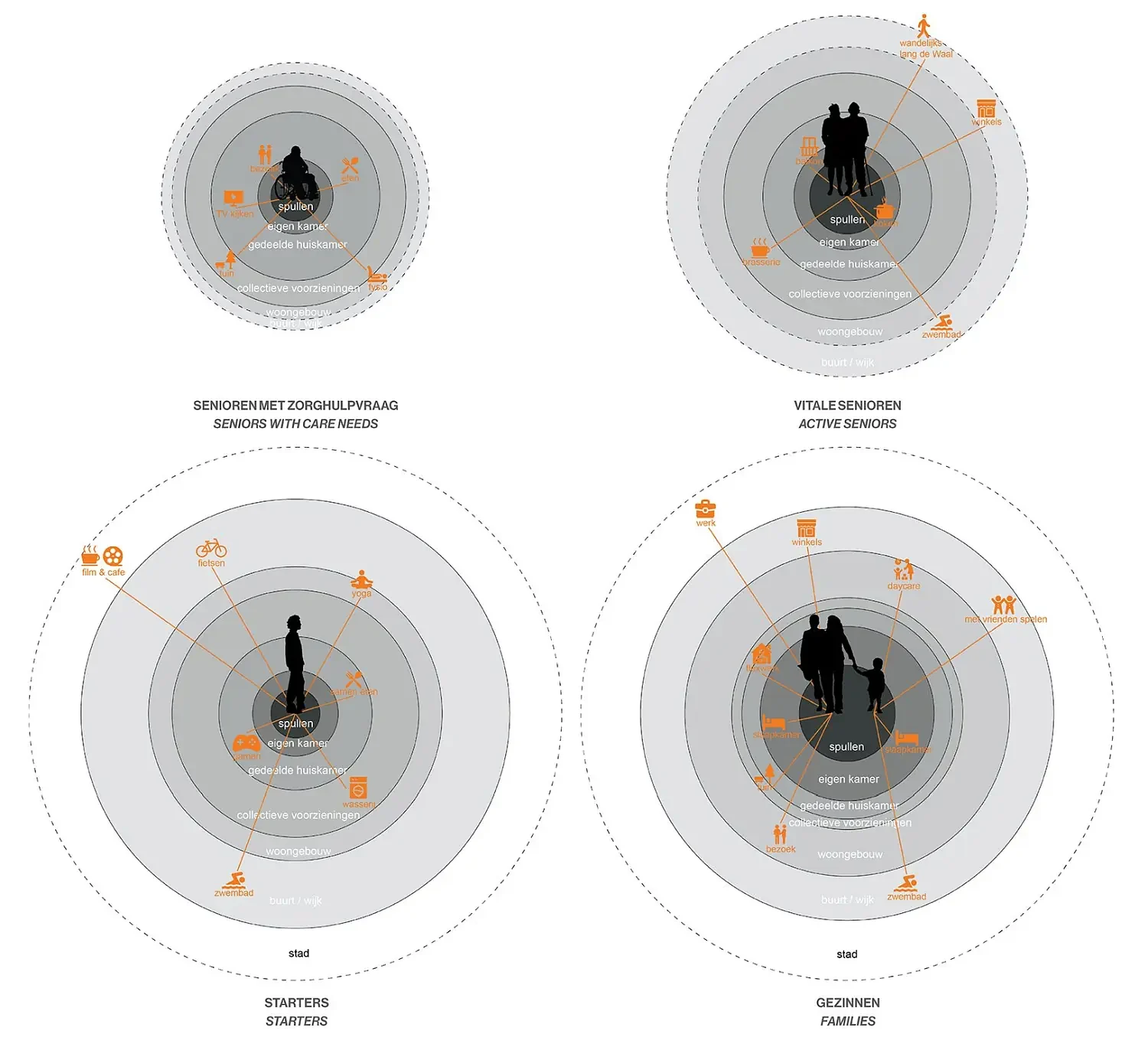
Actieradius diagrams
Renewing existing care buildings
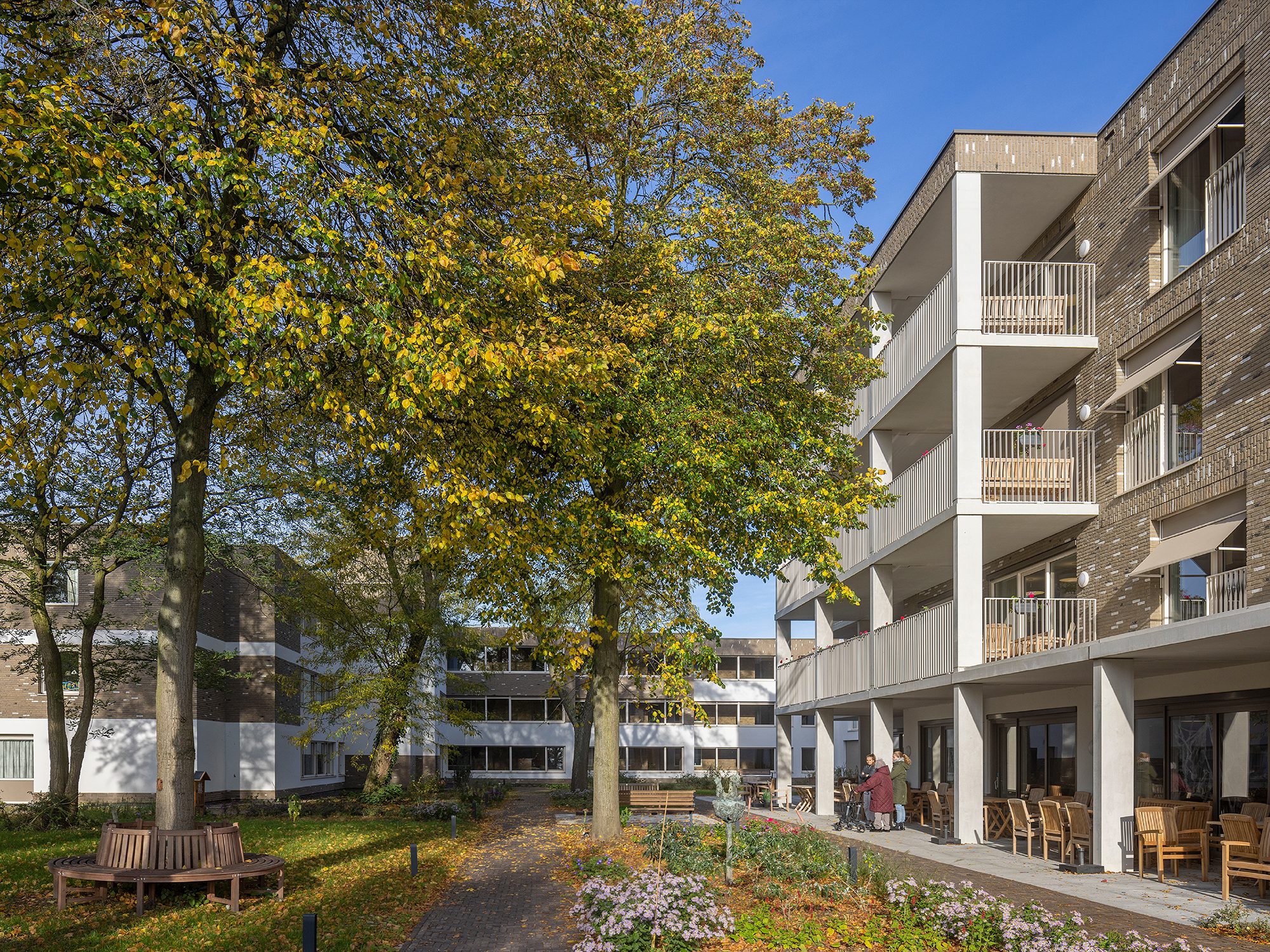
A large number of care complexes from the 1980s and 1990s are now outdated. They reflect a care model focused primarily on manageability: large-scale corridor structures, a closed appearance, and little connection with the outside. Yet it is precisely these buildings that offer opportunities for transformation. By reducing scale, mixing functions, and placing outdoor space at the center, a traditional care home can be transformed into a care community that meets contemporary standards of comfort, sustainability, and personal care.
At Foreschate in Voorschoten, we chose the transition from a residential care home to a modern care community. The new building combines group homes with a neighbourhood center that is open to everyone. Public functions on the ground floor strengthen the connection with the neighbourhood, while the residential floors are organized on a small, manageable scale. The garden acts as a social heart: an accessible, green meeting place that connects residents and neighbourhood.
Breaking through loneliness with spatial logic
Loneliness is one of the great silent health problems of our time. Social isolation increases the risk of depression, cognitive decline, and physical complaints. Architecture cannot solve loneliness, but it can create the conditions for encounter. This calls for a spatial structure in which daily movement leads to natural contact, without that contact being forced.
At Hof van Zutphen, living is organized around a communal garden that structures the entire ensemble. Galleries function as places to linger, and the Hofhuis offers space for activities that bring residents and local people together. The essence lies not in the program me, but in the spatial logic that makes encounter possible. Community-building thus becomes part of daily life, not as an obligation, but as a matter of course.
The value of outdoor space
A caring living environment does not end at the front door. The immediate surroundings shape how people move and take part in the life of the neighbourhood. Walking, gardening, and experiencing the seasons stimulate the senses and reduce stress. Accessible walking routes, recognizable landmarks, and the proximity of amenities support independence. For people with increasing care needs, and certainly in cases of dementia, a legible environment is essential for safety and orientation.
In our designs, outdoor space is therefore always an integral part of the concept, not as leftover space, but as a social heart. A well-designed outdoor space is inviting, supports movement and encounter, and gives rhythm to the day. In this way, health is not only supported within the home but carried by the neighbourhood.
Building communities
The challenges of ageing, dementia and loneliness call not only for more housing, but for different and better living environments. Places where independence and connection reinforce each other. Neighborhoods where people meet and look after each other. Buildings that offer not only shelter, but also meaning, connection and a future.
When health is largely determined by social and spatial factors, architecture becomes a strategic instrument for promoting wellbeing. Not by isolating care, but by weaving it into everyday life.
A caring society does not emerge by itself. It must be designed.