Stories | Healthy Living
Healthy Living
Health does not begin in healthcare, but in the design of our living environment.
Health is a design choice.
Health does not begin at the GP or in the hospital. It begins in the street, the building, the home, the square or the collective courtyard. In the daily environment where people live, work, move and meet each other. That sounds self-evident, but practice tells a different story. In spatial decision-making, health is still often approached too narrowly: air quality, noise levels, external safety. These are real problems with measurable standards. But a neighborhood can meet all standards and still be unhealthy, when encounter is absent, when facilities are too far away, when housing becomes unaffordable or when residents do not feel safe or connected. The World Health Organization defines health not only as the absence of disease, but as physical, mental and social wellbeing. That is a broad definition with a spatial consequence: health is not only something to protect, but also something to actively promote and facilitate. And that begins with how we build and design.
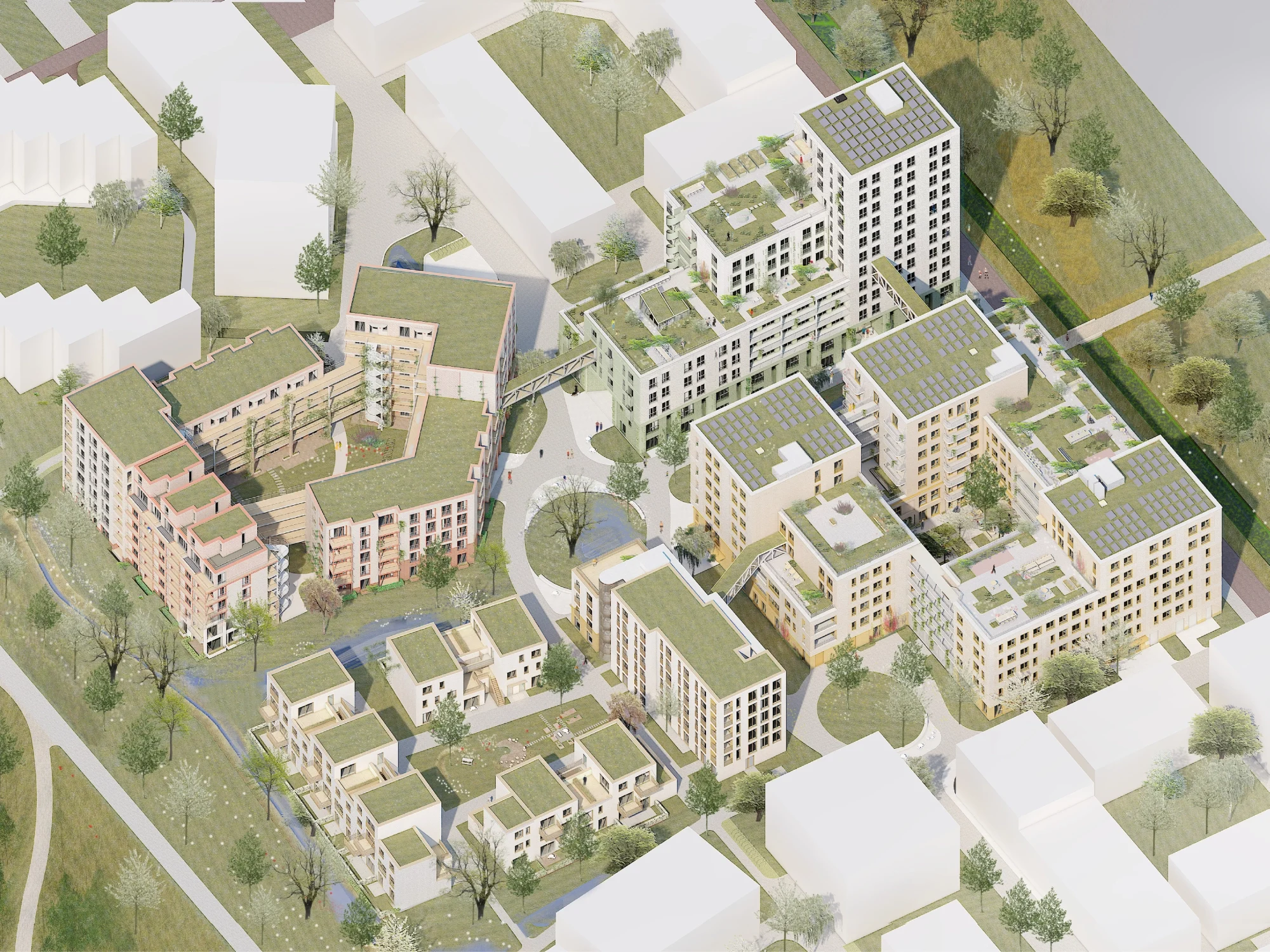
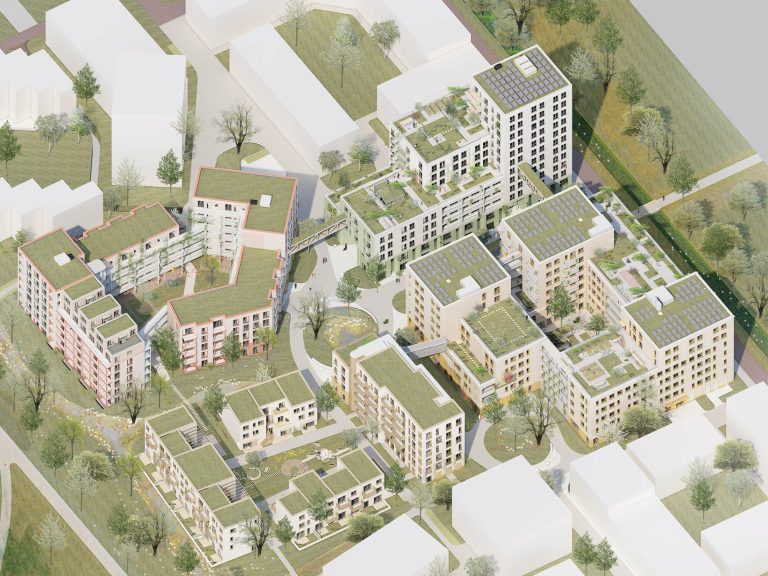
An axonometric view of Living-Inn Winkelsteeg
Unequally distributed
Research by the RIVM and the PBL makes clear that health is unequally distributed. In some neighborhoods, air pollution, heat stress, low income and loneliness accumulate. That accumulation increases the risk of chronic stress, health problems and social isolation. Almost a third of the health differences between higher and lower educated people can be traced back to differences in the living environment. This means that the same spatial intervention does not have the same effect everywhere. An extra cycle path in a neighborhood where people already move a lot has a different impact than in a neighborhood where mobility and social safety are under pressure. Green space is not just a percentage per hectare, but also a question of accessibility, quality of use and social meaning. The analysis of an area therefore begins not only with density or program, but also with the people who live there. Who uses the space? Who stays indoors? Where is the loneliness? Where do health risks accumulate? Only when that social layer is made visible does spatial design gain direction. Data reveal where interventions are needed, but design determines how those interventions take shape.
Our own framework
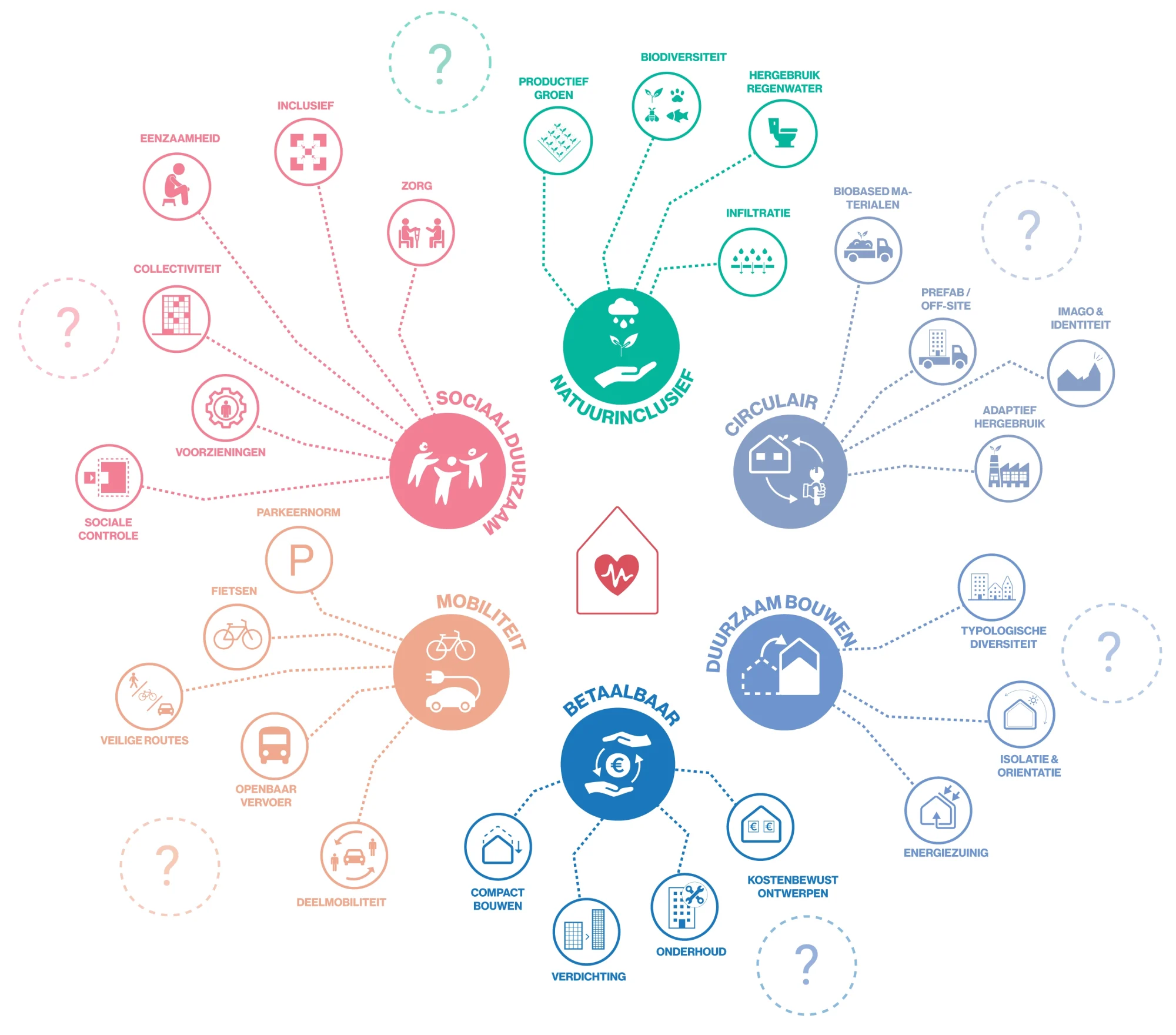
In order to treat health not as a by-product but as the starting point of design, we have developed an integrated framework in which six themes come together as building blocks of a healthy living environment. Not a checklist, but a coherent design framework in which the themes reinforce each other.
New design parameters @ Woonwerk
The six themes are: nature inclusivity, circularity, technical building sustainability, affordability, smart mobility and social sustainability. Together they form a system.
Nature inclusivity as public mental health
Green space reduces heat stress and improves air quality, but at least as important is the social, sensory and mental effect. The presence of green influences how people experience a place: it dampens noise, brings cooling, introduces scents and textures and invites people to slow down. This has a direct, positive impact on stress levels, concentration and general wellbeing. Collective courtyards, shared yards and green gathering spaces create informal encounters. They make it possible for neighbors to meet without an appointment and in doing so strengthen social cohesion. At the same time, these spaces offer rest and restoration, forming a sensorially pleasant and mentally relieving environment. Building more compactly creates space for additional public domain, whereby a courtyard does not become leftover space but the social and sensory heart of the ensemble. Shade, water storage and cooling structures are necessary in a warmer climate, but also determine the mental quality of a place. They contribute to a sense of comfort, safety and relaxation.
Circularity and healthy materials
The materials from which a building is made have a direct impact on the health of residents and on the health of the ecosystem on which we depend. Circular building therefore means not only reusing materials, but also consciously choosing healthy, non-toxic and often biobased materials that support a good indoor climate. By producing building elements in a controlled factory environment, off-site, greater precision is achieved, with less material waste and better quality control. This makes it easier to apply circular materials and results in a more stable and healthier indoor climate. Circularity and off-site production thus together contribute to buildings that consume fewer raw materials, last longer and support healthier living environments.
Sustainability as a foundation
The technical building quality of a structure forms the basis for a healthy indoor climate. Good ventilation provides fresh air and prevents the build-up of moisture. Good insulation contributes to thermal comfort and a stable indoor temperature. Combined with sustainable energy generation, it becomes possible to live comfortably and energy-efficiently. Technical building sustainability is therefore not only about energy performance, but about creating a living environment that is healthy, comfortable and future-proof. It forms the foundation beneath everything else that takes place in a building.
Affordability as a design parameter
International research shows that a lack of affordable housing is strongly associated with health problems. Financial stress, unstable living situations and forced relocations have direct consequences for mental and physical health. Affordability is therefore for us not a financial aspect but a design parameter. Building compactly, smart densification and cost-conscious choices ensure that a healthy living environment remains accessible and inclusive, for everyone, not only for those who can afford it.
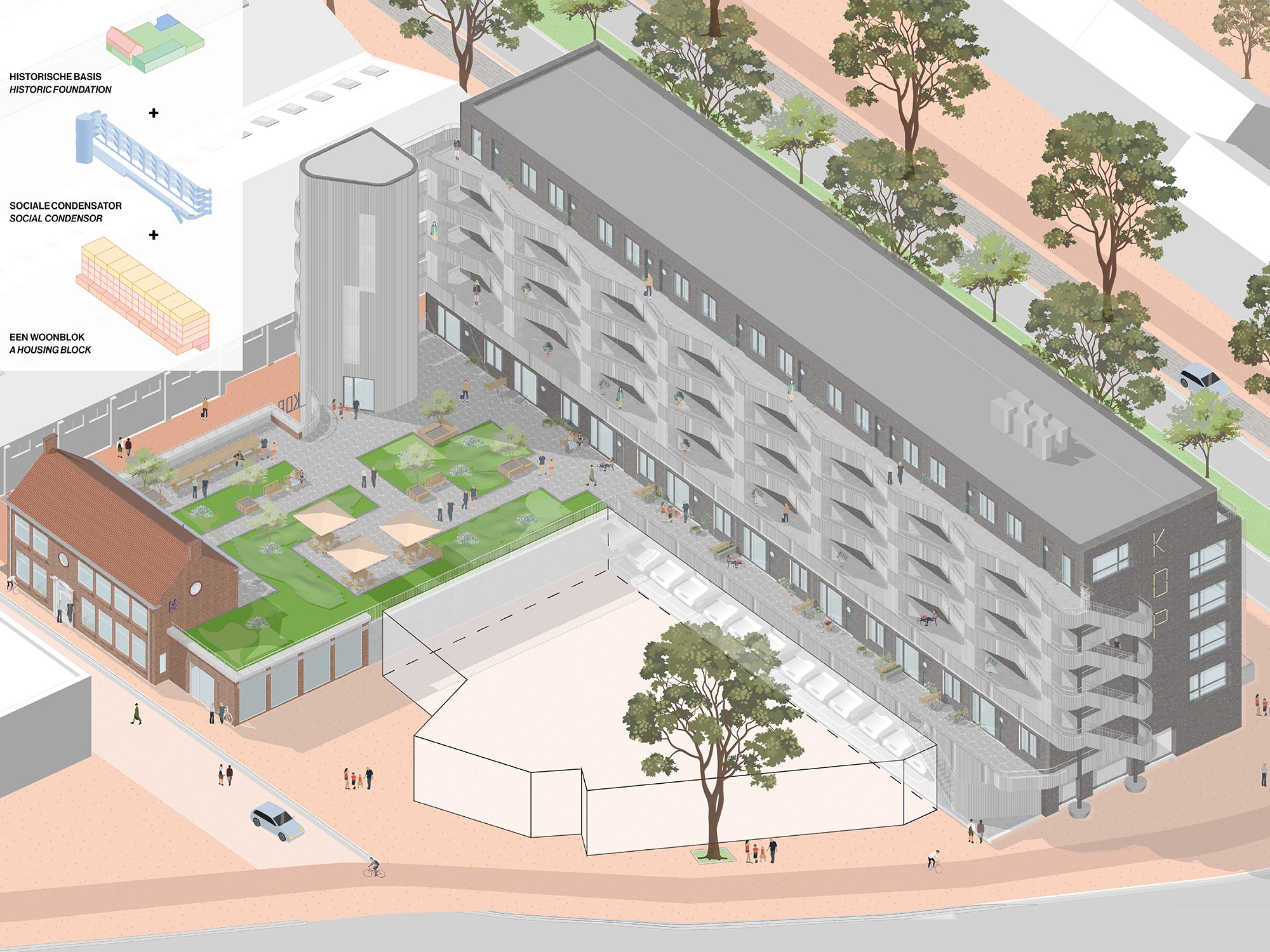
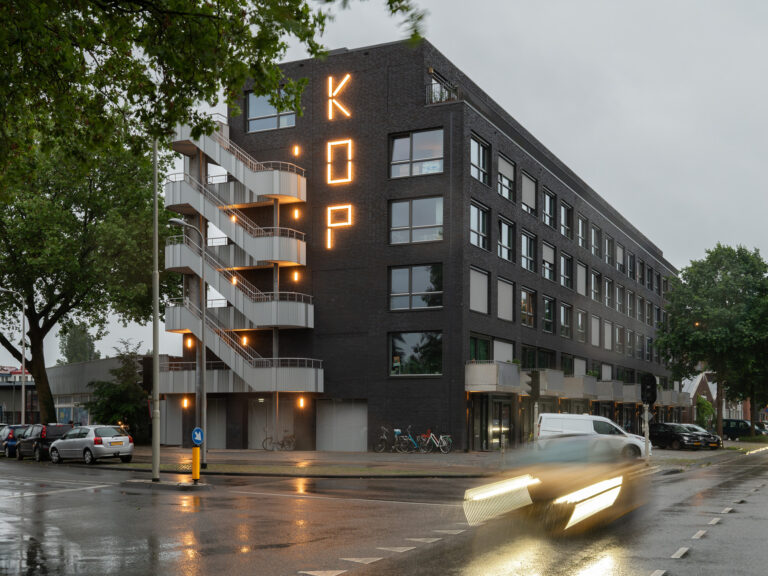
An axonometric view of KOP Havenkwartier
Smart mobility as a health strategy
Car-free structures create space for walking and cycling, reduce noise and improve air quality. But they do more than that: they turn streets into places to linger rather than spaces to pass through. The street once again becomes a place where children play and encounter happens. When daily facilities, workplaces and recreation are within walking and cycling distance, an natural form of daily movement emerges. Proximity reduces dependence on the car, lowers stress and increases autonomy. The concept of the fifteen-minute city is therefore not only a mobility concept, but a health strategy. In our projects we organize program, routing and plinths in such a way that encounter and daily movement become self-evident. Good integration into the existing urban fabric is the starting point.
Social sustainability
Housing forms with shared spaces, from collective gardens to communal workspaces, strengthen social networks and make informal encounter self-evident. At a time when loneliness and mental health complaints are increasing, housing typology is not only a market question but also a health question. The way buildings are organized largely determines how often people encounter each other and how strong social bonds can grow. A slightly wider gallery, a shared entrance or a collective courtyard can serve as a transitional space between private and public, where spontaneous interaction becomes possible. Social sustainability goes further than encounter alone. A healthy living environment also requires accessible facilities, proximity to care and an inclusive design of neighborhoods in which different generations and income groups can live together. When those facilities are nearby, a network of mutual support emerges that strengthens self-reliance and collective resilience.
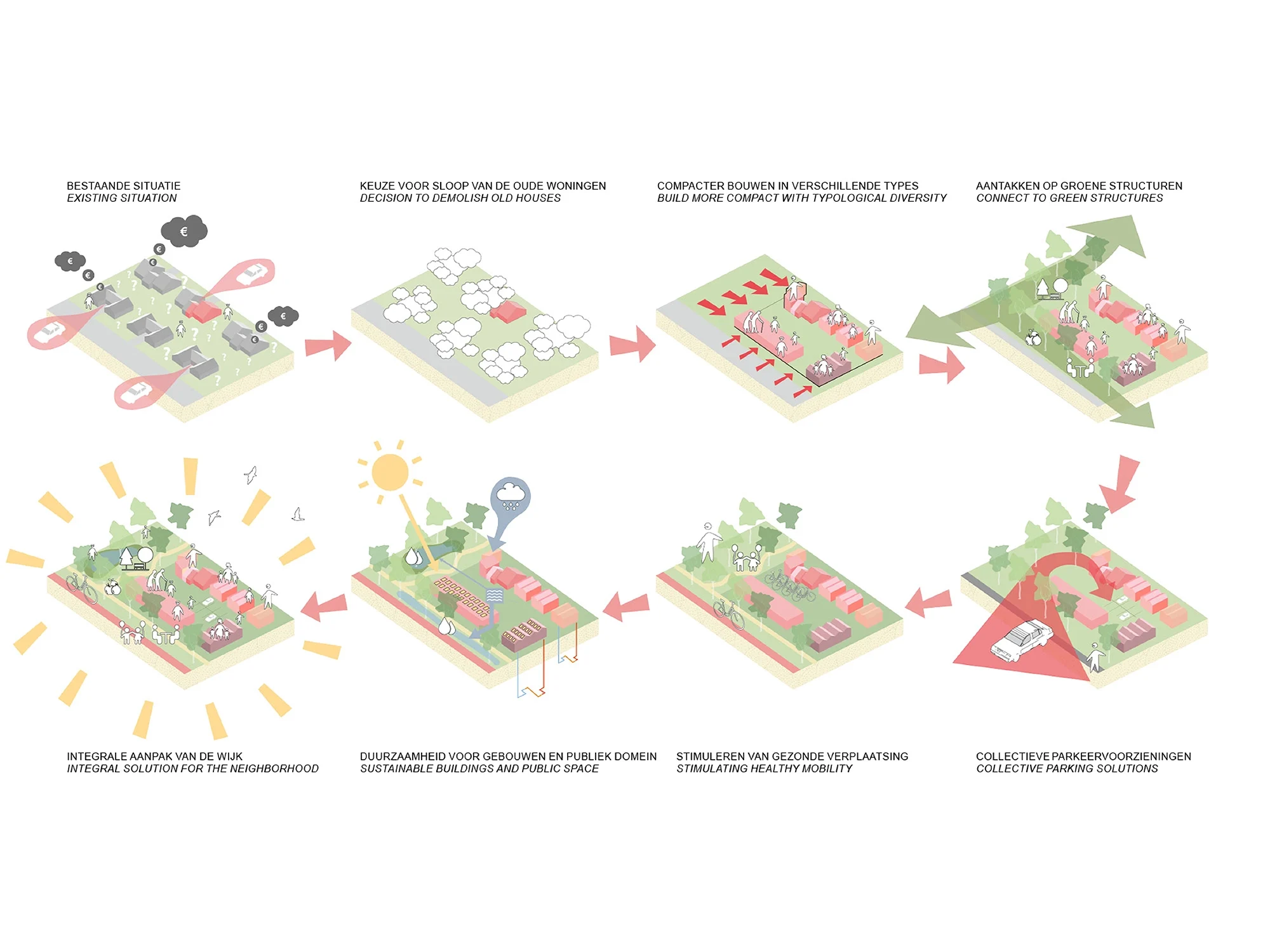
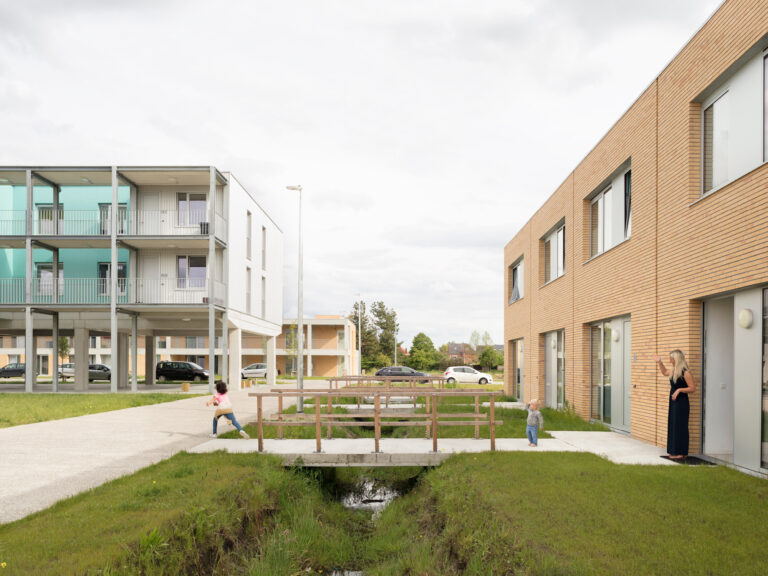
Applying design parameters @ Kleine Kouter
From standard to ambition
In spatial policy, health is often assessed as an improvement or deterioration of indicators. We see health as an ambition: not only meeting standards, but raising minimum thresholds where vulnerability is greatest. Not only adding homes, but facilitating communities. Not only adding green space, but positioning it strategically so that it is actually used. A healthy living environment is not a sum of separate measures. It is a carefully designed social-spatial system in which protection, promotion and facilitation come together. The living environment does not only protect against disease. It determines opportunities to move, to meet each other, to find rest, to live affordably, to grow old in good health.
Health does not begin in healthcare. It begins in the design of our neighborhoods and buildings.
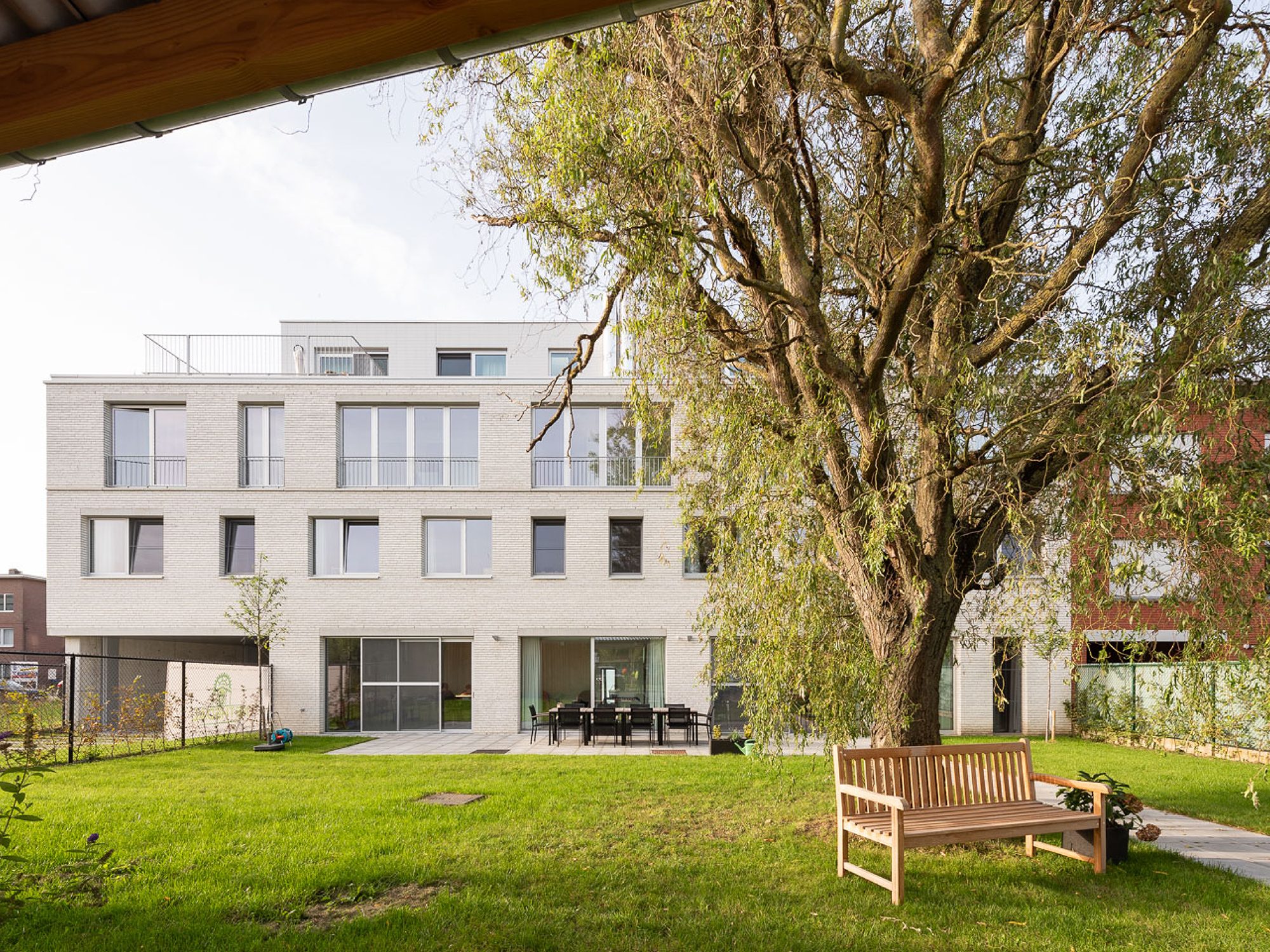
The back garden @ Lively in the street