Stories | Off-site
Off-site
Industrial precision as a response to a societal challenge
The construction sector is under pressure. In Flanders and the Netherlands, more than 1.4 million new homes must be built by 2035, while at the same time environmental pressure is increasing, construction costs are rising, and the shortage of skilled workers is growing more acute. Traditional construction methods are increasingly hitting their limits. Sites are delayed by weather conditions, logistical complexity is increasing, and failure costs remain high. Research into the Dutch construction sector shows that failure costs in traditional construction projects can amount to 10% of the total construction sum. This is not a minor issue; it is a systemic problem. Market research further indicates that labour shortages and productivity pressure will continue to increase in the coming years. The classic, craft-based site organisation is insufficiently scalable to deliver the housing construction challenge on time and affordably.
The question is therefore not whether we need to build differently, but how. Woonwerk believes that the future of construction lies in more efficient, cleaner, and more controlled production processes. Off-site construction methods, where components or complete modules are produced in a factory and only then assembled on site, offer a response to both technical and societal challenges. Off-site construction is not a technological hype for us. It is a structural shift in how we think about design, production, and impact.
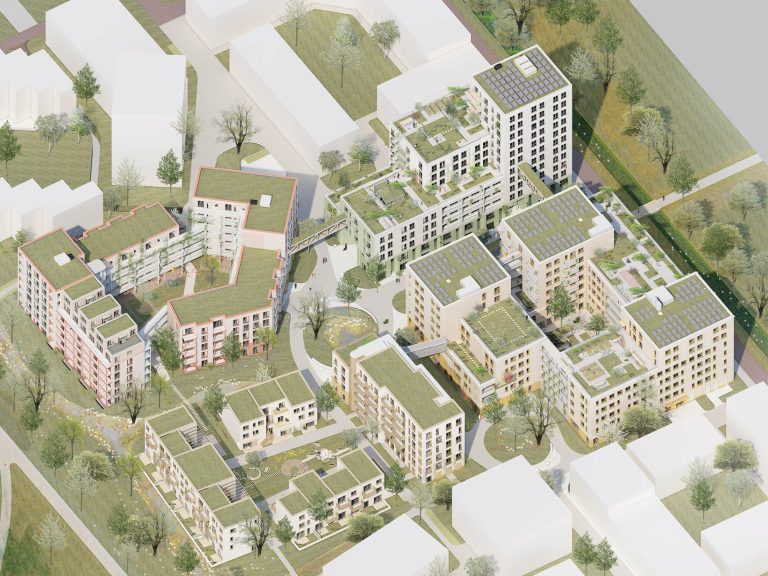
An axonometric view of Living-Inn Winkelsteeg
From site to factory
Off-site construction refers to the factory-based production of building elements (walls, floors, facade elements, or even complete modules) in a controlled environment. Only then are these elements assembled on site into a finished building. This shift from site to factory has major consequences. In a controlled environment, work can be carried out more precisely, weather influences are excluded, and processes become repeatable and measurable. This leads to less material waste, fewer errors, and higher quality. International comparisons show that construction time can be reduced by 30 to 50%. Less construction time means lower financing costs, less disruption to the surroundings, and faster availability of homes.
We are not thinking here of mass-produced containers or uniform housing units with their limitations in spatial freedom, facade expression, and integration into the existing environment. We work with flexible 2D and 3D systems that allow customisation, respond to context, and meet high architectural standards. Timber frame and solid timber construction make biobased and circular building scalable. Steel frame construction offers solutions for energy renovations and repeatable facade systems. Modular 3D units allow technical services, bathrooms, and kitchens to be pre-integrated, dramatically reducing error vulnerability on site. These systems can be combined in hybrid solutions. Standardisation of principles does not mean standardisation of form.
Why this shift is necessary
The transition to off-site production is not merely a technical choice. It is a societal necessity. The housing construction challenge demands speed without loss of quality. Prefabrication enables shorter lead times and reduces dependence on scarce craftsmanship on site. The construction labour market is ageing, and new entrants remain insufficient. Industrialisation of building processes makes more efficient use of available expertise. Sustainability also plays a decisive role. Traditional construction causes considerable material losses and transport movements. Off-site production minimises waste, optimises material use, and makes logistics more efficient. Less transport, less site waste, and controlled production lead to a lower CO₂ footprint. Lighter timber frame structures also reduce nitrogen emissions during transport and installation, no small advantage in the current construction context.
Circularity becomes more readily achievable when connections are dry and demountable. Elements can be adapted, reused, or relocated. The factory enables precision; precision enables reuse. Affordability is also a crucial factor. Through predictable production, lower failure costs, and shorter construction time, risks are reduced. Risk reduction translates into cost control. This is essential in a market where affordable housing is under pressure.
Urban planning and standardisation: freedom through system
A persistent misconception is that prefabrication leads to uniformity, to neighbourhoods that look the same everywhere. In reality, off-site construction offers precisely more design freedom, provided the system is intelligently set up. The power lies in the repeatability of principles, not in the copying of forms. A carefully designed module can adapt in material, orientation, facade appearance, or function. Linkability and stackability make it possible to deploy the same system on a detached plot, as a terraced house in an existing street, or as a multi-family building in an urban context, each time with its own character.
This is relevant from an urban planning perspective. Off-site systems that allow design freedom in facade materials, roof shapes, and configuration can integrate into the existing built environment without reducing it to a catalogue neighbourhood. Standardisation resides in the structural principle and production logic, not in architectural expression. In this way, we combine the efficiency of industrial production with the sensitivity of architecture.
The 2D/3D construction system: modular housing without limitations
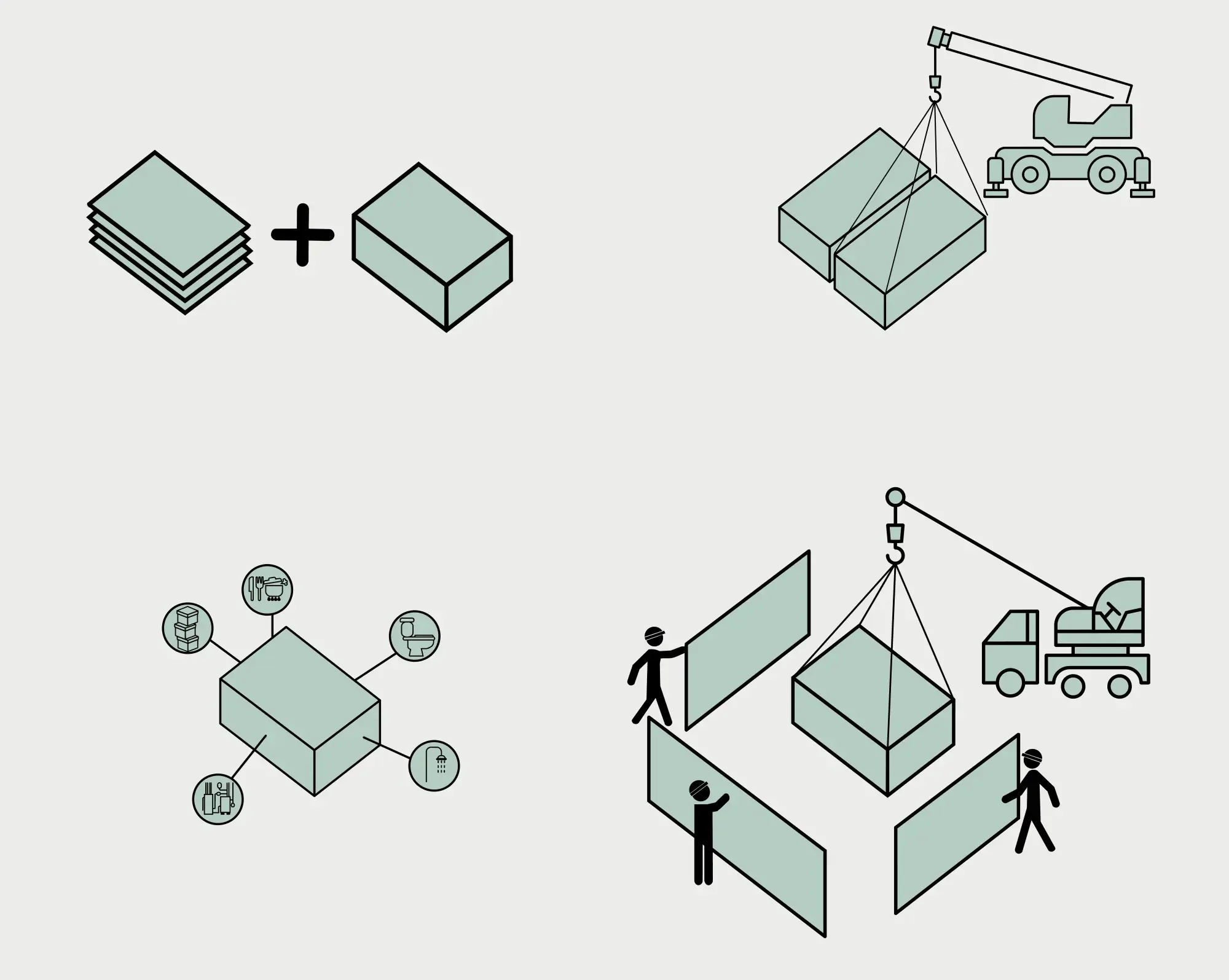
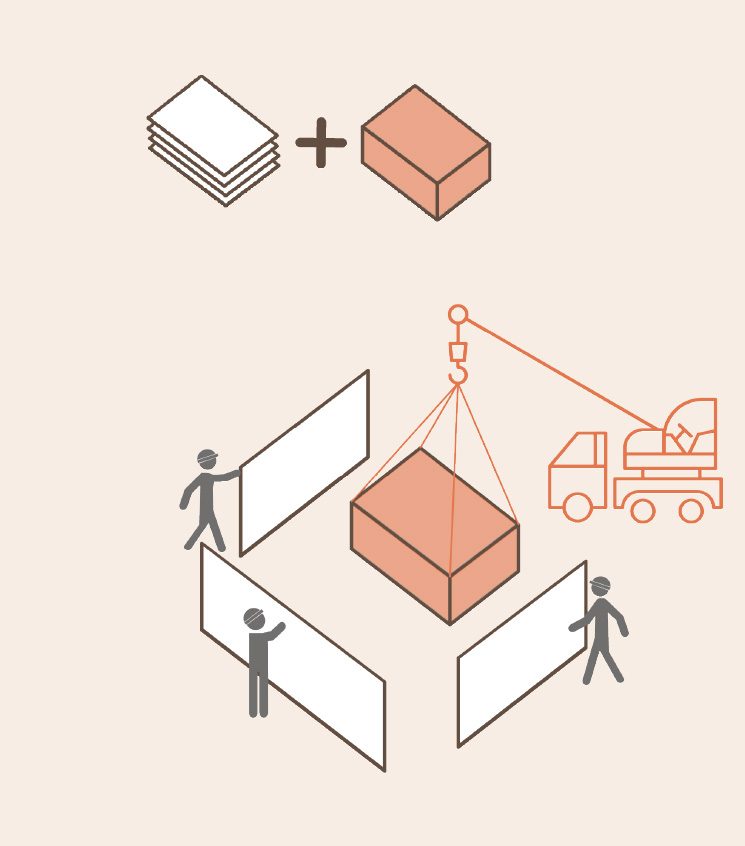
Within this vision, Woonwerk developed its own 2D/3D construction system: a prefab building concept that combines the advantages of industrialised production with maximum freedom in spatial planning and typology. The system consists of two complementary components. A compact 3D unit contains all sanitary and technical installations: kitchen, bathroom, toilet, storage, and technical services. This unit is delivered fully finished and plug-and-play ready. Because the development cost of this unit is greatest, it has been deliberately designed to be applicable to various housing types, from studio to three-bedroom home. The 2D building elements (walls, floors, and roofs in timber frame construction) are produced entirely off-site, are demountable, and allow great freedom in spatial planning. Technical conduits are integrated into the elements and are mutually pluggable. The result is a system that is linkable and stackable, adaptable to a wide range of urban planning contexts, and deployable for both temporary and permanent projects. Through-apartments with day and night zones, without windows in the side facade, enable compact linking, a quality that conventional container homes typically lack. The housing types are furthermore designed in accordance with the design guidelines of Wonen in Vlaanderen, for types of 1 to 5 occupants, with the same 3D unit as the basis. One identical unit, endless variation in housing types.
2D-3D system
Transport, local production, and the logic of the system
Off-site construction changes not only the building site, but also the logistics chain. Because elements can be transported in a standardised and stacked manner, the number of transport movements to the site decreases considerably. This has direct advantages for the surroundings (less nuisance, lower emissions) as well as for planning: the site becomes more predictable and shorter in duration. The lighter timber frame structures are an additional advantage here: they are easier to transport and install than heavy concrete elements, resulting in a smaller nitrogen footprint.
At the same time, industrialisation of the construction process offers opportunities for local economies. By collaborating with regional timber frame builders and producers of building elements, knowledge and production capacity are built up locally. In this sense, off-site construction is not a threat to craftsmanship, but a reorganisation of it: from site to factory, from incidental execution to controlled quality. This requires different competencies, but also creates new employment in a sector under pressure.
Our vision in practice
In our projects, we always seek the balance between technical innovation and spatial quality. Off-site construction is not a standard solution for us, but a design strategy that we reinterpret for each project, in close collaboration with construction companies, social housing associations, and materials experts.
Group Housing Ter Heide, Aarschot
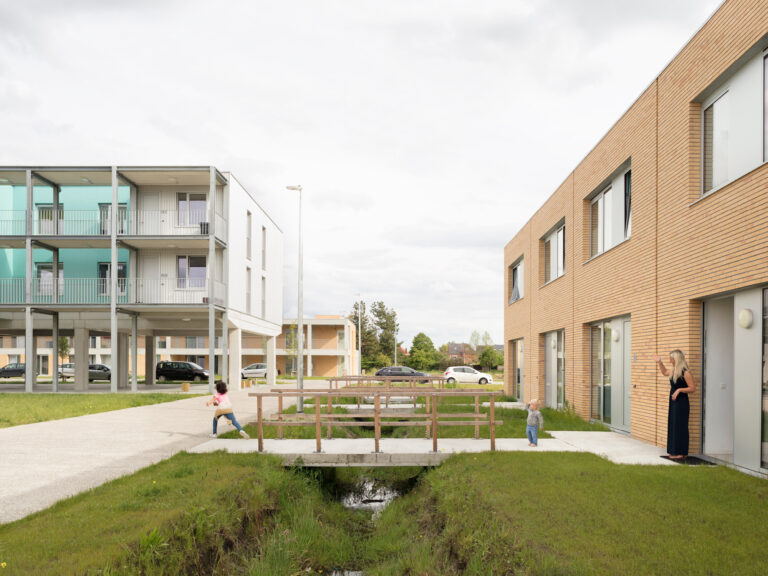
In collaboration with Hooyberghs nv, we investigated various construction systems to achieve a maximally circular, biobased, and affordable result. The combination of solid timber construction and timber frame facades, together with circular interior walls and natural insulation, led to a halved construction time and a cost comparable to traditional construction, but with a considerably lower environmental impact.
Infill Acaciawijk, Sint-Stevens-Woluwe
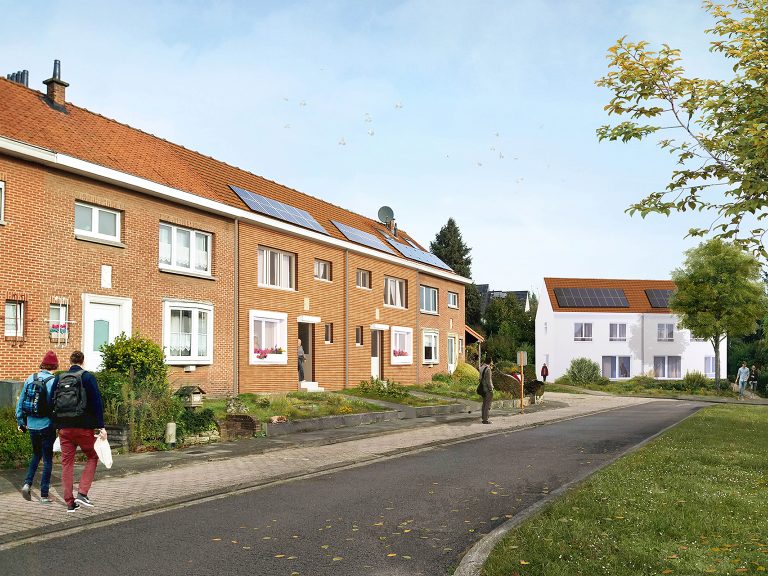
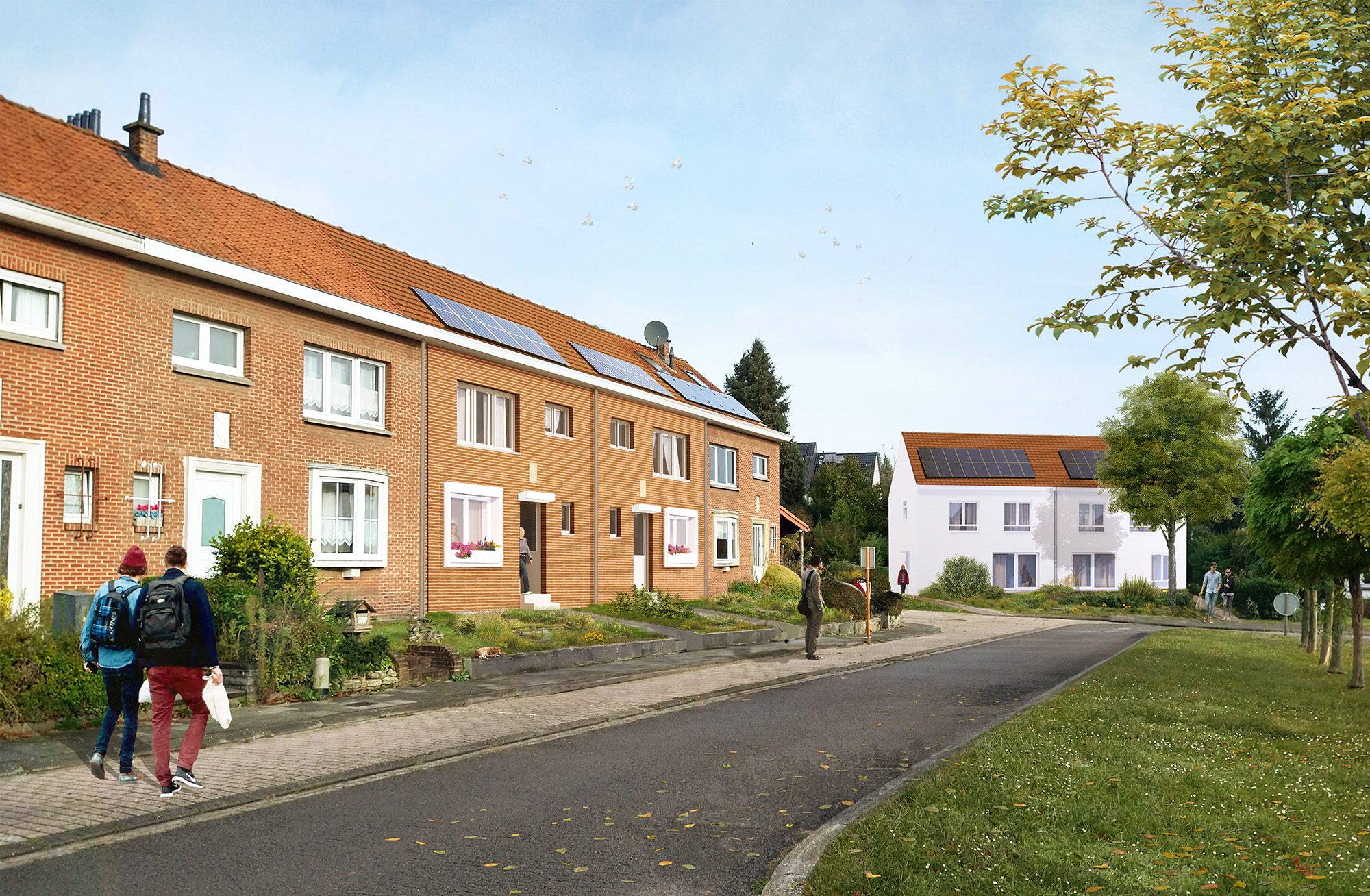
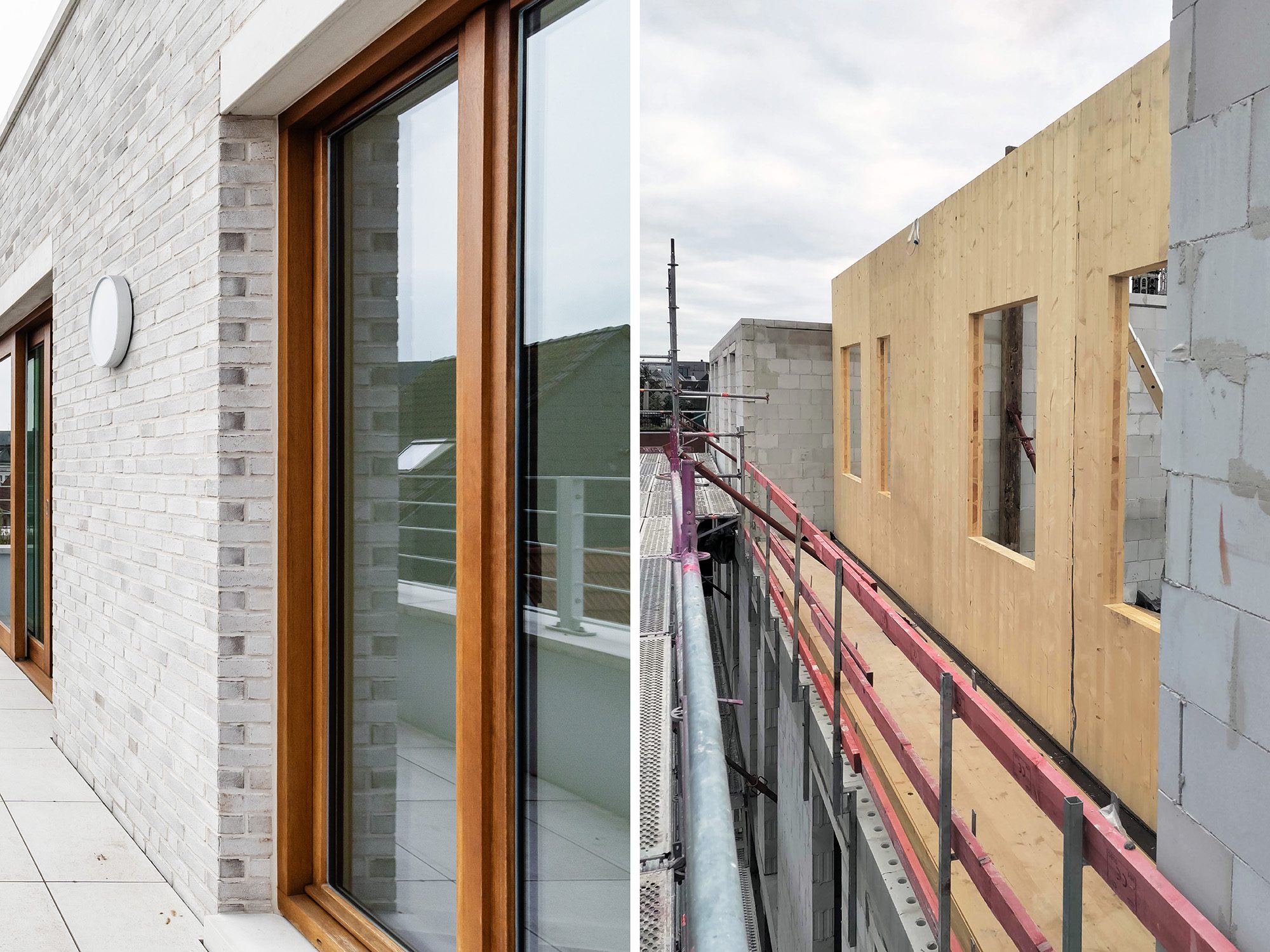
With Dethier nv, MBS nv, and social housing association Woontrots, we realised a project in which new off-site produced timber frame homes were inserted between existing buildings. The 2D walls and floors were produced entirely in the factory; on site, only the facade brickwork was executed in situ for natural integration into the historic neighbourhood. The limited site duration and rapid assembly minimised disruption to the neighbourhood.
Oudemansstraat, Antwerp
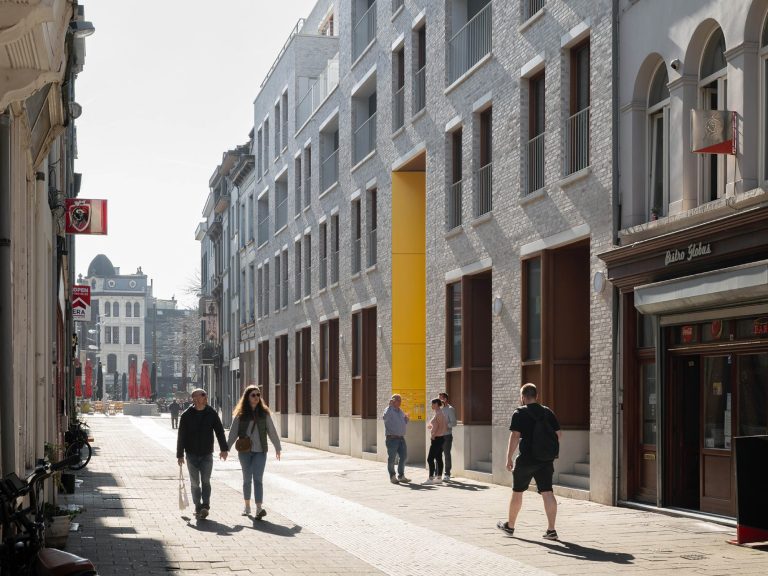
For this urban transformation project, timber construction was strategically deployed as a light and fast structural solution within an existing structure. By working with CLT and timber structural elements, new volumes could be added without placing a heavy load on the existing load-bearing structure.
D&B 2024: Type Homes for Social Housing
Together with Everaert Cooreman and MBS nv, we developed type homes in off-site timber frame construction, designed for adaptability and linkability. The freedom in facade layout and stacking means the system can be applied to various locations without imposing uniformity. Repeatability lies in the principle, not in the image.
D&R 2024: Energy Renovations
For the renovation of social homes in Flanders, we developed prefab steel frame facade elements that can be easily attached to existing structures. This method significantly reduces site duration and improves energy performance without major demolition.
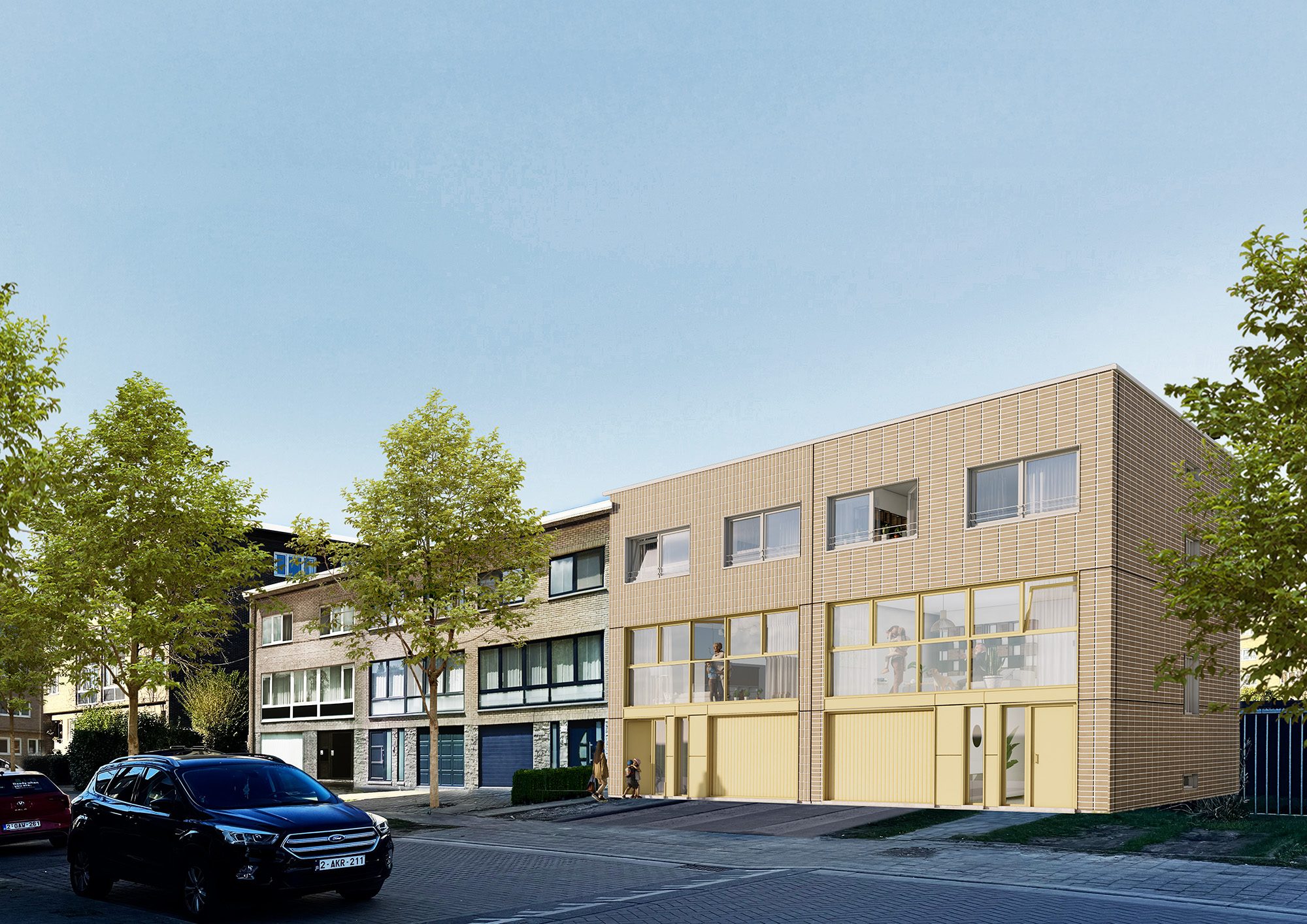
D&R Energetic renovations
Innovative 2D/3D Prefab Construction System
Woonwerk developed a new construction concept in which a compact 3D unit with technical services and wet rooms is combined with flexible 2D building elements. The system is fully demountable, adaptable, and deployable for both temporary and permanent projects, from transitional housing to stacked apartment buildings. Three prototypes were permitted in collaboration with MBS nv and Woontrots.
Building better
We see off-site construction as an integral part of sustainable design. From the very first sketch, we think about modularity, material flows, logistics, and circularity. Off-site construction is not a goal in itself for us. It is a means to build better, with less waste, less impact, and greater precision. With a construction culture in which affordability, ecology, and quality reinforce rather than exclude one another.
The housing construction challenge calls not only for more homes. It calls for smarter, cleaner, and more sustainable ways of making those homes. Off-site construction is not a promise for the future in this regard. It is an approach that works today.