Stories | Nature-inclusive
Nature-inclusive and regenerative construction
The built environment as part of a living system
Cities are densifying. The climate is changing. Biodiversity is under pressure. And yet construction continues as though the built environment and the natural environment were two separate worlds: one hard, the other green.
Woonwerk believes this distinction is outdated. Buildings, neighbourhoods, and cities are part of ecosystems. They can put further pressure on those ecosystems, or they can actively contribute to them. That choice begins with design.
Nature-inclusive construction is not a trend for us, and not a checklist. It is a design attitude that permeates every scale: from the layout of a neighbourhood to the choice of a climbing plant on a facade, from the way rainwater is managed to the position of a nesting box in the brickwork.
Rooftop Antwerp
From nature-inclusive to regenerative
There is an important distinction between these two ambitions. Nature-inclusive construction focuses on preserving and strengthening biodiversity: making space for plants, insects, birds, and small mammals, and arranging the built environment so that it supports their presence rather than excluding it.
Regenerative construction goes a step further. It strives for buildings and landscapes that actively contribute to the restoration of the natural environment: to soil, water management, air quality, and local ecosystems. Not merely causing less damage, but adding value. In our projects, we aim to take that second step. Every project is an opportunity to improve a piece of the environment, not only for the residents, but also for the broader ecosystem of which that environment is a part.
Compact building as an ecological strategy
One of the most impactful choices in a project is also the most fundamental: how much space does the building footprint occupy? Compact building is not only more budget-friendly and more sustainable in material use. It is also the key to more green space. Every square metre that is not built or paved is a square metre that can contribute to ecology, water capture, and quality of life. This principle sounds simple, but has far-reaching consequences for how a masterplan is conceived.
In our projects, we strive for maximum de-paving and a blue-green network that permeates the entire site. Cars are grouped at the edge of the site or underground, so that the interior can be organised free of cars and ecologically. Parking spaces are laid out in grass-concrete tiles and embedded in greenery, designed so that they can be converted to regular green space when parking demand decreases. In several of our residential projects, this results in a ratio where more than two thirds of the plot is green, with only one third paved or built. This is not coincidental, but the direct result of deliberate urban planning choices.
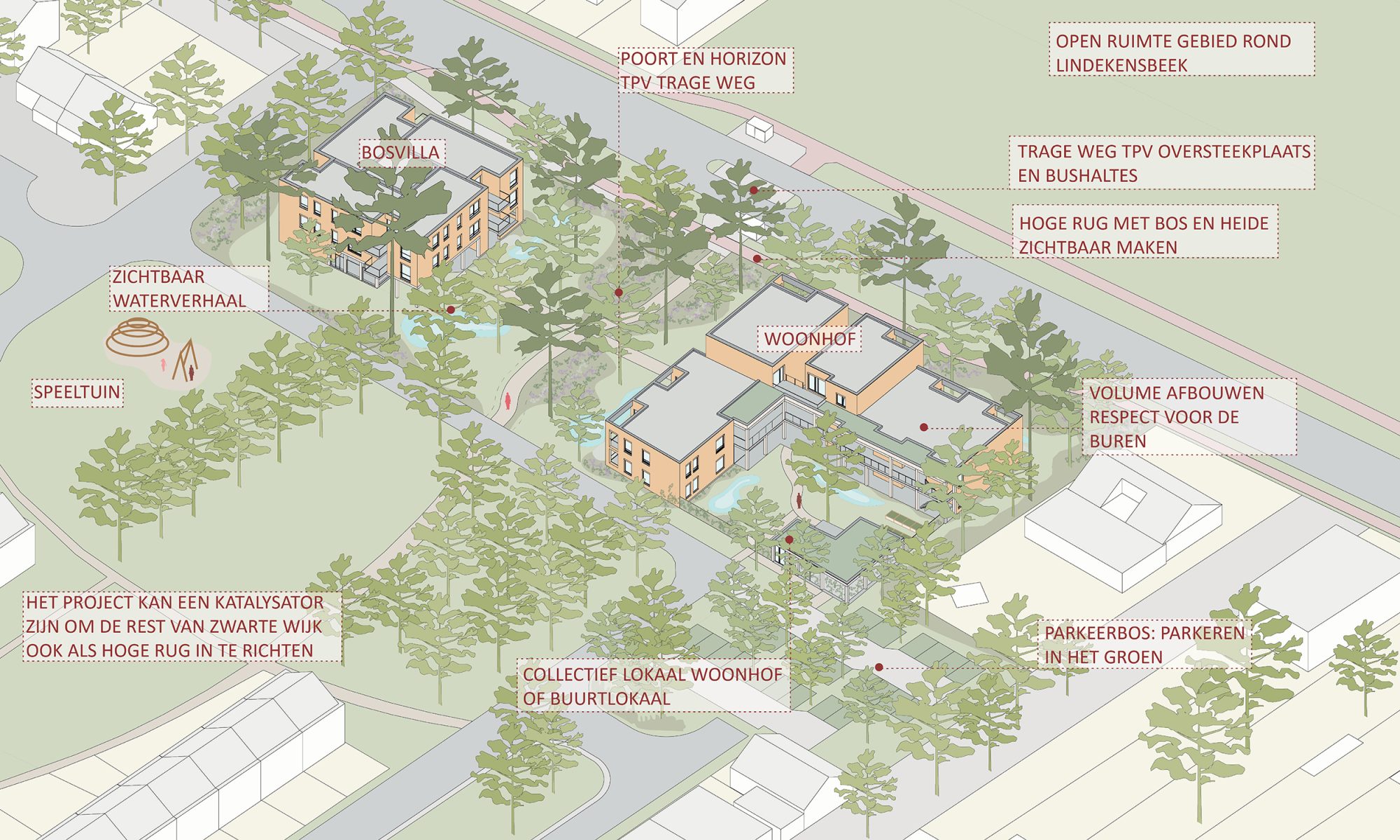
Axo 3D Tweebunder, Nijlen
The blue-green network: making water visible
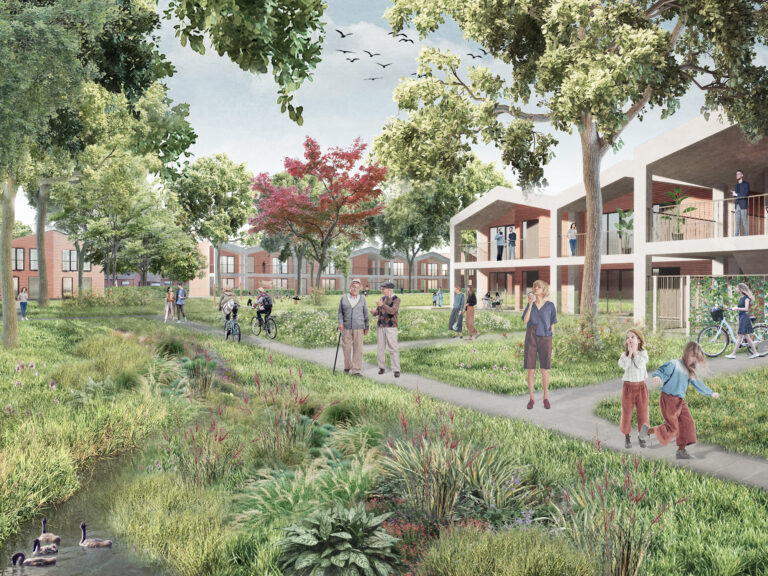
Nature-inclusive design and sustainable water management are inextricably linked. Paving prevents infiltration, accelerates runoff, and increases the risk of flooding. The solution is not technical in nature. It is spatial. In our projects, we work with above-ground blue-green networks in which both private gardens and public green spaces are used for water retention and infiltration. Rainwater is not discharged via sewers, but kept visible: it flows from roofs into above-ground rainwater storage, from there into shallow wadi’s, and thus infiltrates into the soil on site.
This visibility is intentional. When residents can see the rainwater flowing, buffering, and infiltrating, they become aware of the cycle of which they are a part. The water story thus also becomes an educational story.
Green roofs play a dual role here: they evaporate a large portion of precipitation, reduce heat stress, provide habitat for insects and small animals, and improve the thermal performance of the building.
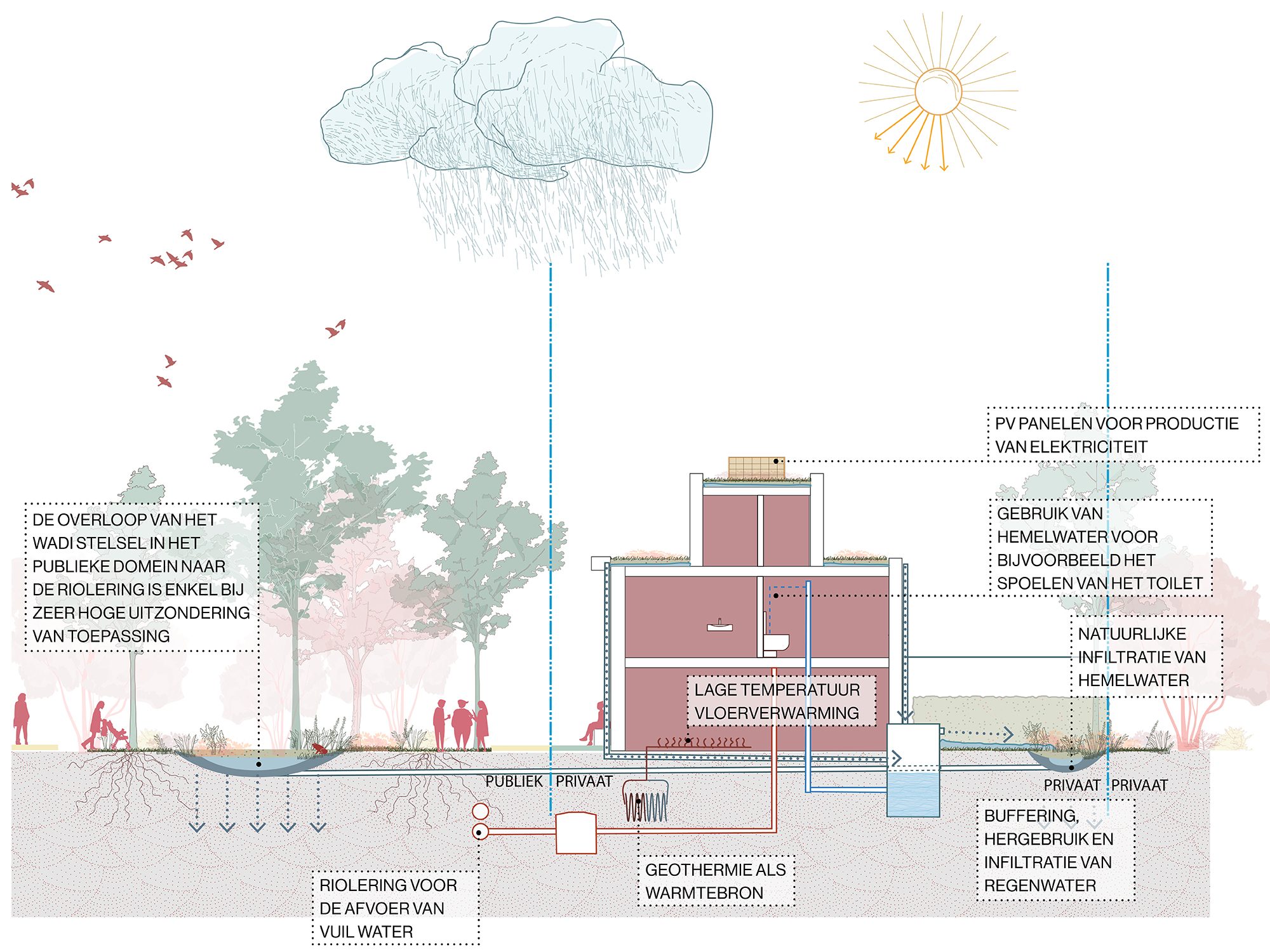
Water collection system
Biodiversity at building scale
Nature-inclusive construction does not end at the edge of the plot or at the foot of the facade. It also concerns what the building itself does for its surroundings. In our projects, we systematically integrate nesting boxes and roosting places into facades, roofs, and structural details. The boxes are precisely integrated into the facades, with the correct orientation and height. House sparrow boxes and swift boxes are always placed in clusters, as both species are colonial breeders for whom a single box is insufficient. Bat boxes provide overwintering opportunities and, for some species, nesting possibilities as well. All these elements are not added as accessories after the fact, but developed as an integral part of the facade design. Facade planting contributes in a different way. Climbing plants such as honeysuckle, climbing hydrangeas, and various fruit-bearing climbers create vertical greenery that attracts insects, feeds birds, and improves the thermal quality of the facade.
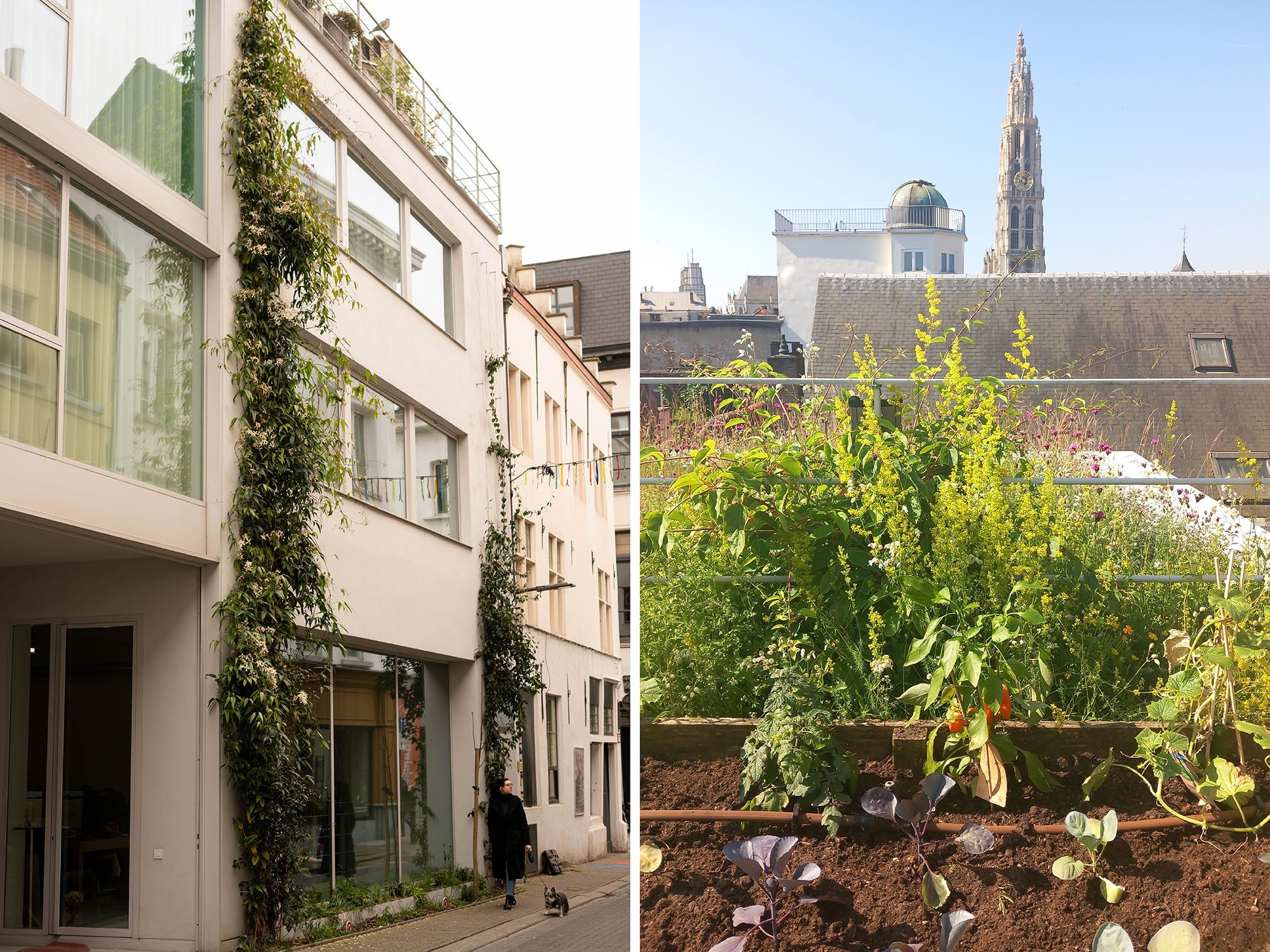
Antwerp office and rooftop
Planting as ecosystem, not decoration
The choice for native, locally appropriate planting is a principled one. Native species are adapted to the local climate and soil conditions, form a balanced ecosystem with the local insects and animals, and require less maintenance in the long term. We maintain an absolute minimum of 40% native species. For green roofs, different rules apply: the dry, permeable substrate and exposure to wind and heat call for drought-resistant, often Mediterranean species alongside the native ones.
We consistently work with layered planting: a herbaceous layer, a shrub layer, and a tree layer that together form a rich ecosystem. Foraging hedges, copses, and hedgerows of edible species add value for fauna and residents alike. Existing valuable trees are inventoried and preserved as much as possible. They represent decades of growth and ecological value that cannot be replaced by newly planted trees. In neighbourhood projects, the ambition extends beyond the site itself. By investing in locally native planting that connects with existing green structures in the surroundings, we aim to contribute to a broader ecological network that reinforces itself as the puzzle pieces find each other.
Our vision in practice
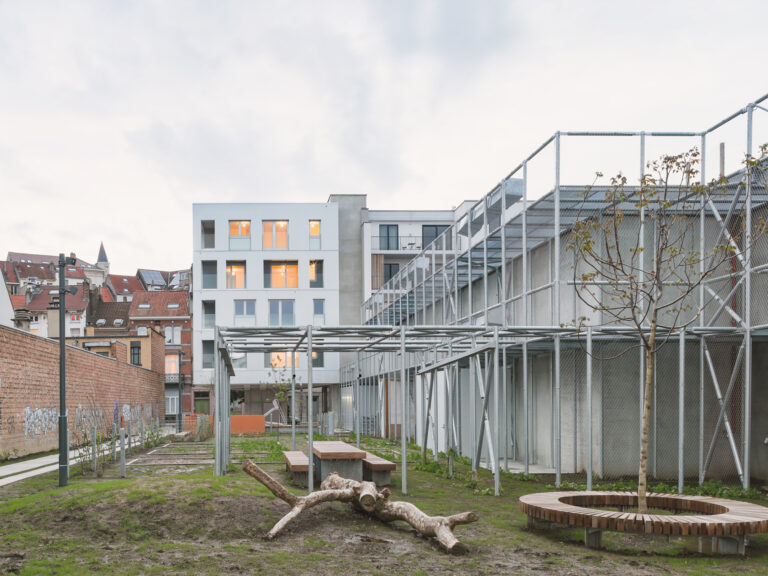
School and Jardin des Moineaux, Ixelles
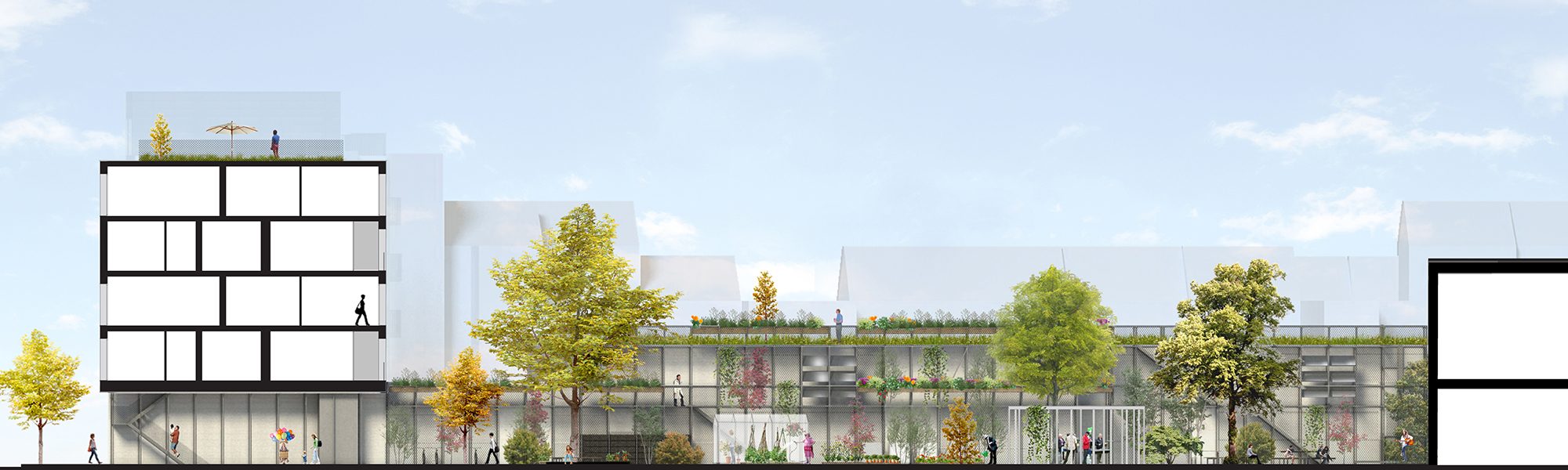
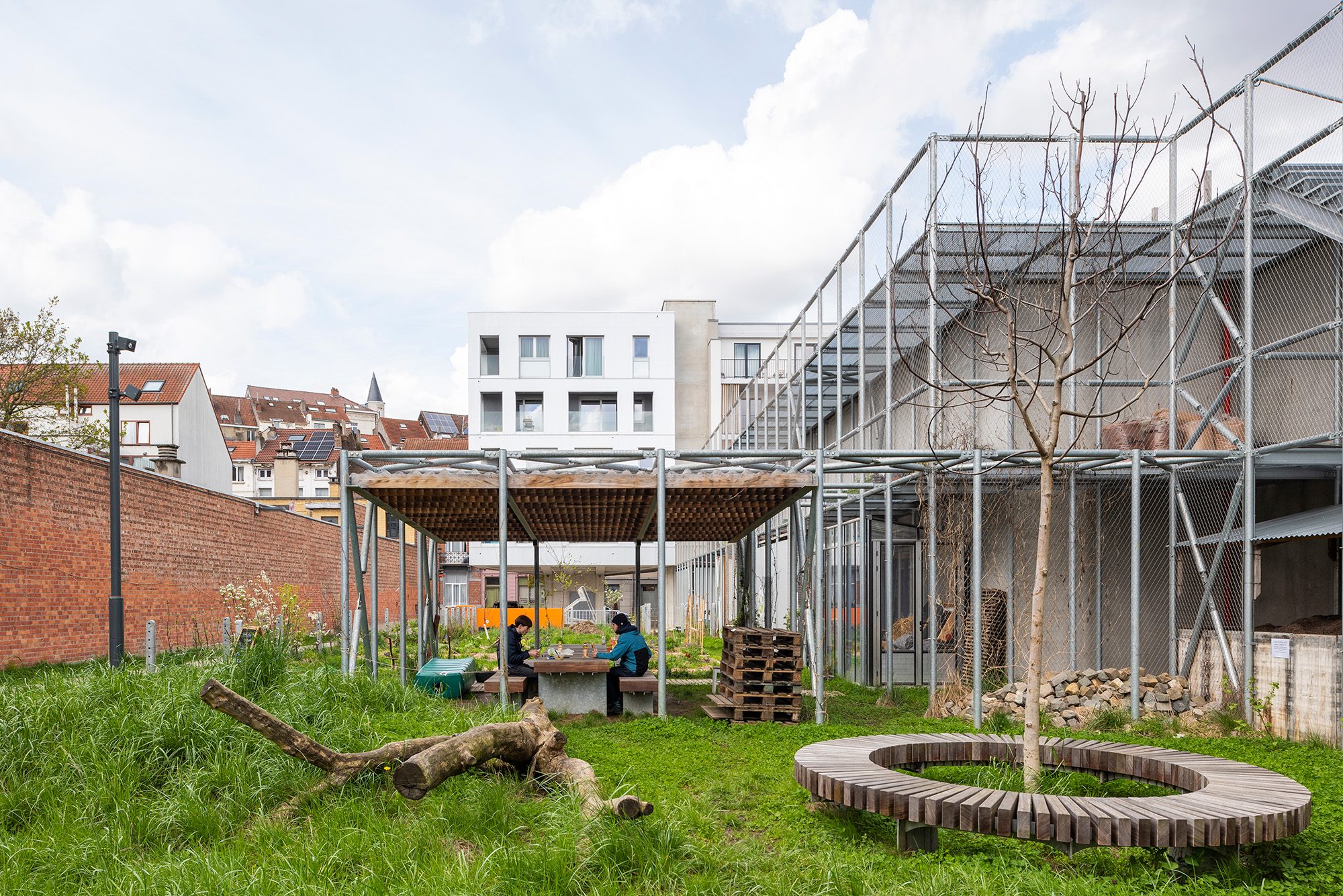
On a compact urban site in Ixelles, we combined the renovation and extension of a primary school, the construction of new passive social apartments, the redesign of the Sparrow Garden as a community garden, and access to the adjacent Colruyt roof as an experimental ULB urban farming project. The community garden forms the ecological heart of the site. Native planting in a layered structure (herbs, shrubs, and climbing plants) attracts insects and birds and creates a micro-ecosystem in the middle of the city. A scaffolding structure along the Colruyt facade transforms a blank fire wall into a vertical green element, connecting the ground-level garden with the 1,500 m² roof garden above.
The buildings themselves also actively contribute. Virtually all roofs are designed as green roofs, processing 80% of rainwater on site. Facade planting is developed by orientation: shade-tolerant species to the northwest, Mediterranean herbs to the southeast as a living garden laboratory for pupils. House sparrow boxes in clusters, swift boxes, and bat boxes anchor the buildings in the broader ecosystem. In this way, an anonymous interior courtyard was transformed into a green lung connecting school, residents, neighbourhood, and urban farming.
Vlastuin, Kuurne
In the centre of Kuurne, we transformed a closed, paved interior courtyard into a public village garden. By solving all parking for 34 social housing units underground, the entire ground level was freed up for greenery and public space. Wadi’s buffer and infiltrate rainwater on site, with a realised capacity that considerably exceeds the legally required minimum. Climbing plants on the street facade, existing trees, and landscaping in a natural style make this dense urban project a piece of nature in the heart of Kuurne.
Wonen in de Putse Tuin, Rumst
The Putstraat in Terhagen was transformed from a narrow, paved street with a large-scale social apartment block into a green corridor connecting the Nieuwstraat with the Terhage forest area to the north. Sixty surface parking spaces moved to an underground car park; in their place came greenery, a footpath, and a neighbourhood park with a vegetable garden and a picking garden. More than half of the site is public green outdoor space. Wadi’s infiltrate rainwater on site.
Kleine Kouter, Neerwinden
For the transformation of this post-war social housing estate in Neerwinden, we developed a strategy in which compact building creates space for a green heart that structures and connects the entire neighbourhood with the adjacent Waarbeek valley. Parking is collectively bundled in courtyards, designed so that they can be modularly converted to greenery as parking demand decreases. Wadi’s keep rainwater above ground and simultaneously serve as play elements and ecological habitat. Locally native planting in a layered structure, foraging hedges, and a vegetable garden strengthen biodiversity.
Tweebunder, Nijlen
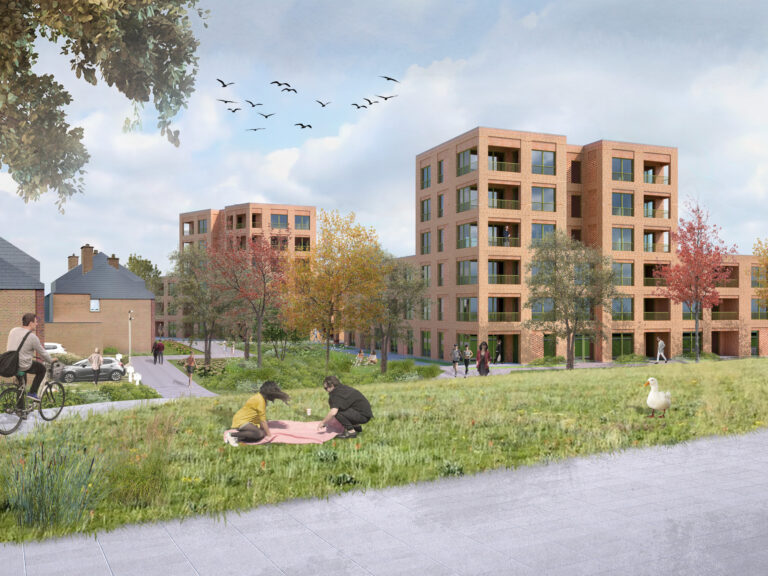
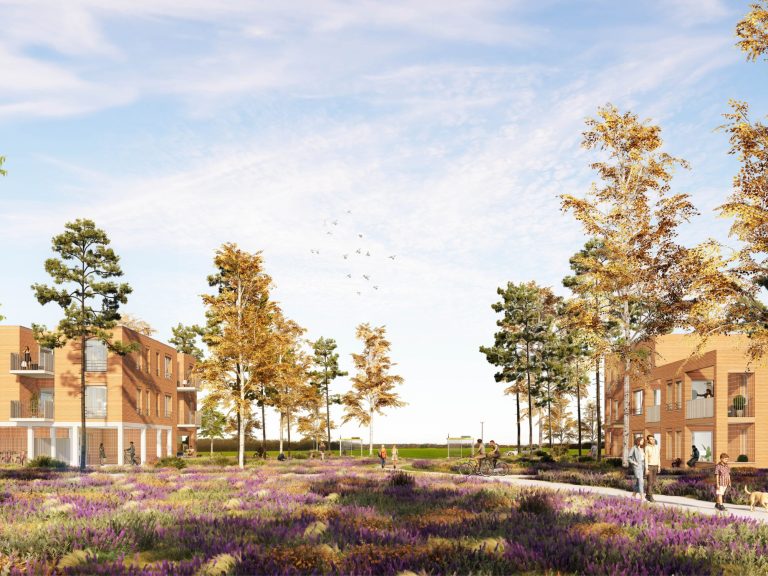
For this social housing site in Kessel, we developed a plan based on the landscape structure of the ‘High Ridges’ (Hoge Ruggen), a mixed woodland and heathland zone that is fragmentarily present in the region. 65% of the site is green; parking takes place in a parking woodland in grass-concrete tiles that can gradually evolve into regular woodland as parking demand decreases. All rainwater is retained on site via above-ground wadi’s. Nesting boxes are designed as an integral part of the brickwork.
Our Own Office, Antwerp
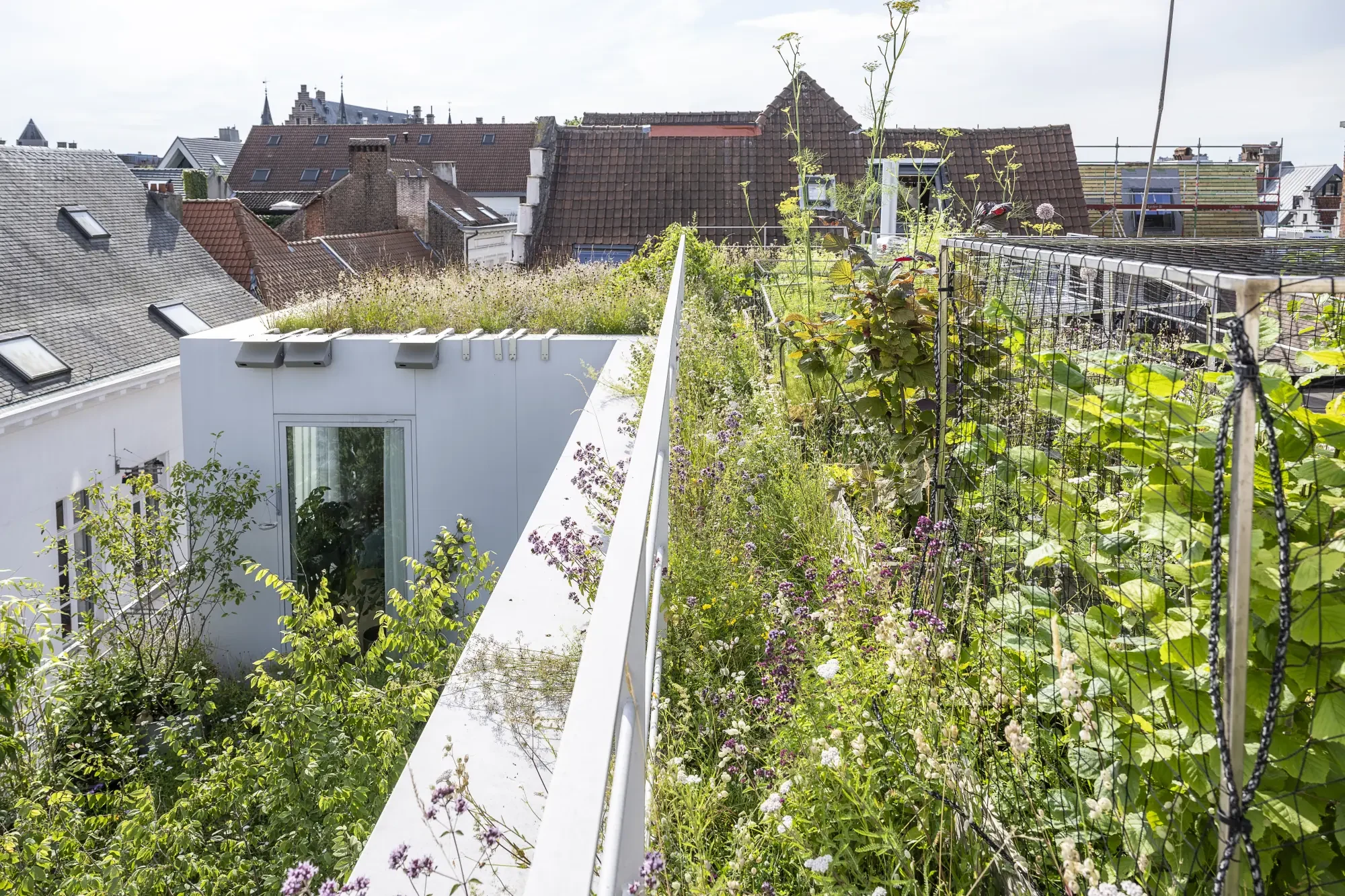
On the green roofs and facade garden of our own office in Antwerp, at least 40% of the planting consists of native species, combined with Mediterranean herbs that thrive well in the microclimate of green roofs. The planting is structured in three layers and forms a layered ecosystem. On a surface area of 120 m², more biodiversity has been observed than on comparable agricultural land or a traditional lawn, and in some cases even more than in urban parks that are too heavily designed without room for spontaneous natural development.
Low maintenance through naturalisation
An additional advantage of this approach is the low maintenance requirement. By choosing natural, largely native vegetation and a design that responds to natural processes (water capture, soil improvement, spontaneous seeding), a system emerges that gradually brings itself into balance.
This process of naturalisation means that green spaces become more robust as they age. They require less intervention, are more resilient in times of drought or heavy rainfall, and become ecologically more valuable over time. This is a fundamentally different logic from traditional garden maintenance, where greenery must constantly be tended to look ‘tidy’. Well-designed nature does not always look tidy. But it works.
An integrated design framework
Woonwerk approaches every project with an eye for the ecological context and technical feasibility. Nature-inclusive and regenerative construction is not a separate theme alongside other sustainability ambitions for us. It is interwoven with our approach to affordability, social sustainability, water management, and healthy living.
Compact building creates space for greenery. Greenery improves the microclimate and reduces heat stress. Above-ground water management strengthens the ecology and makes the neighbourhood more climate-resilient. Native planting requires less maintenance and increases biodiversity. Nesting boxes and facade planting make the building an active participant in the ecosystem. All these elements reinforce one another. That is the essence of regenerative design: not fitting into nature, but contributing to its restoration. The built environment is not an adversary of the ecosystem. It can become part of it.